Says
What did the person actually say? Include a short quote.
An empathy map helps a team organize what it has heard and observed about a person in a specific situation. Use it after interviews, a field visit or a service test. It is a way to discuss evidence and gaps, not a substitute for asking people about their experience.
English template
Use this templateMake your own copy and edit it. Sign in or create an account to open it in the editor.
A shared summary of user observations and a clear list of assumptions to validate in the next conversation.
Use these questions alongside the areas on the board. Add one idea per note, then discuss the connections.
What did the person actually say? Include a short quote.
What might they be thinking? Distinguish expressed thoughts from your assumptions.
What action did you observe in this situation?
What emotion did they express? Mark any interpretation as a hypothesis.
Define whose experience you are discussing and at what moment. Avoid combining very different users into an imaginary average person.
Add short quotes and observed actions from research notes. Remove identifying details when they are unnecessary for the discussion.
Thoughts and feelings may be interpretations. Mark them as hypotheses unless the person expressed them, and link them back to the observation that prompted them.
Compare the areas and identify what you still do not know. Write two or three open interview questions instead of jumping straight to a solution.
Keep what fits, rewrite what does not and set the pace for your group.
Templates are included in the free plan. Participation limits depend on your plan. See plans.
Whiteboard30–45 min
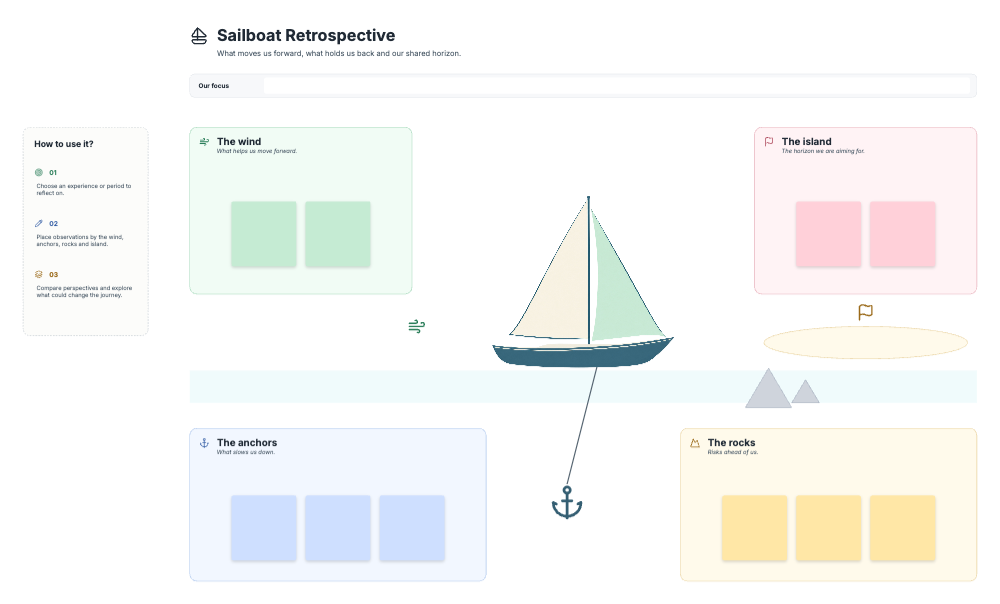
Run a sailboat retrospective on a ready-made whiteboard. Explore goals, helpful forces, obstacles and risks, then agree one concrete experiment.
Explore the activityWhiteboard30–45 min
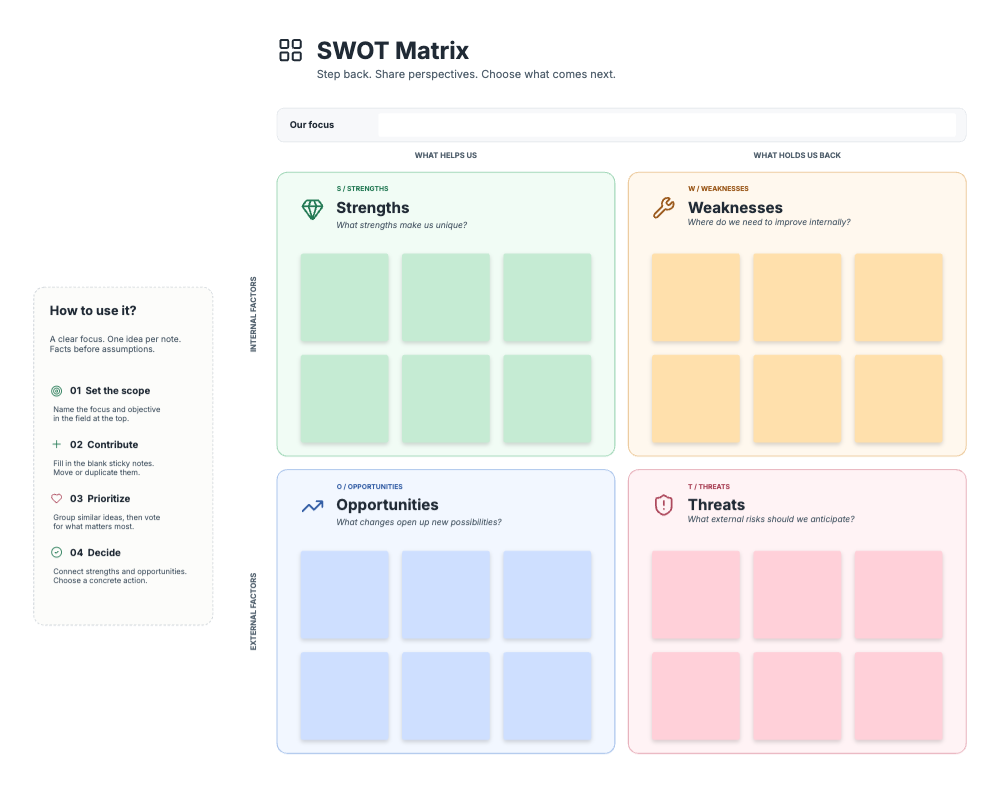
Complete a collaborative SWOT matrix with strengths, weaknesses, opportunities and threats. Includes prompts, a worked example and facilitation steps.
Explore the activityWhiteboard20–30 min
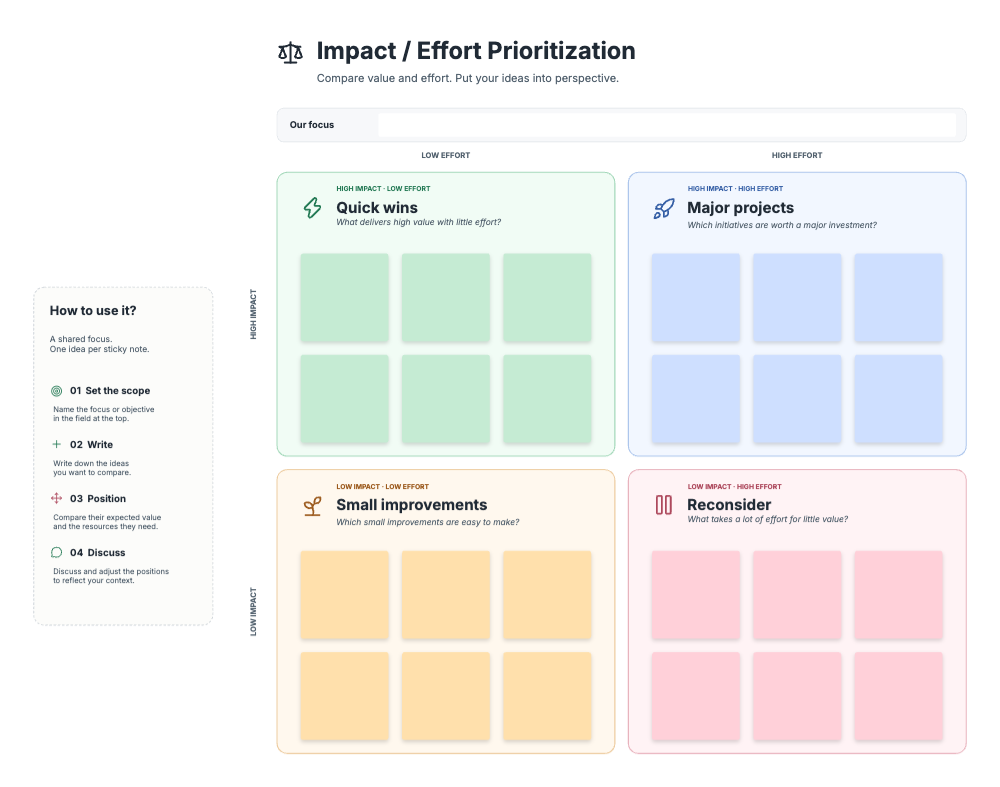
Compare ideas by expected impact and effort on a collaborative matrix. Define the axes, discuss uncertainty and choose the next action together.
Explore the activity