
Quiz / session

Ancient Rome quiz: 20 questions with answers

Which liquid did the Romans use to wash their clothes? What does “alibi” mean in Latin? This ancient Rome quiz brings together 20 questions about daily life, emperors, monuments, the army, the games and Latin words still in use. Every answer is explained and checked against reference sources, and everyone votes on their phone.

Time including discussion:
15–20 min
For:
Elementary and middle school teachers, families, youth clubs, libraries and fans of the ancient world

English template · 20 questions · Updated on

Use this template

Make your own copy and edit it. Sign in or create an account to open it in the editor.

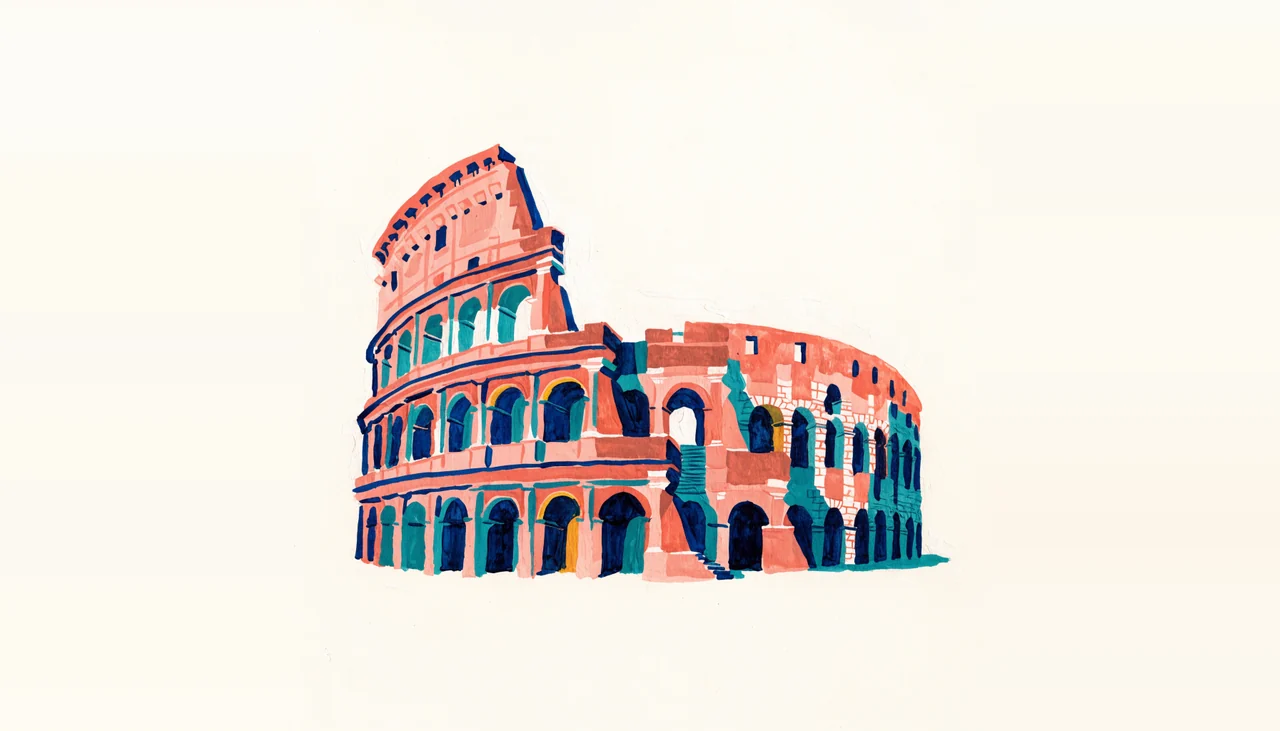
Cover illustration of the template “Ancient Rome quiz: emperors, gladiators and Latin”
Question 1 of 20

According to the legend of Rome’s founding, which animal fed the twins Romulus and Remus?

What you can leave with

A ready-to-launch quiz to review ancient Rome or open a history unit, with verified answers.

All questions in this template

Open a question to see its answer, explanation and source. You can adapt the wording and order in the editor.

  1. 1. According to the legend of Rome’s founding, which animal fed the twins Romulus and Remus?
    • A she-bear
    • A goat
    • A she-wolf
    • A doe

    Answer: A she-wolf

    The legend places the scene in a cave, the Lupercal. On Rome’s famous Capitoline Wolf statue, the twins were added during the Renaissance.

    Source: Wikipedia — Romulus and Remus

  2. 2. In Roman numerals, which number is written with the letter L?
    • 50
    • 500
    • 100
    • 1,000

    Answer: 50

    C stands for 100, D for 500 and M for 1,000. The Romans, however, had no symbol at all for zero.

    Source: Wikipedia — Roman numerals

  3. 3. What were the large public baths where Romans washed and met up called?
    • Forums
    • Arenas
    • Basilicas
    • Thermae

    Answer: Thermae

    Bathers moved from the hot room (caldarium) to the cold plunge (frigidarium). The largest bath complexes even had libraries.

    Source: Wikipedia — Thermae

  4. 4. Who was the very first Roman emperor?
    • Julius Caesar
    • Augustus
    • Tiberius
    • Caligula

    Answer: Augustus

    His great-uncle Julius Caesar was never emperor: he was dictator. The month of August is named after Augustus.

    Source: Wikipedia — Augustus

  5. 5. What was the Pont du Gard, a Roman structure in southern France, used for?
    • Carrying water
    • Defending a border
    • Storing grain
    • Serving as a temple

    Answer: Carrying water

    This 1st-century aqueduct bridge crosses the Gardon river to supply Nîmes, then called Nemausus. It became a UNESCO World Heritage Site in 1985.

    Source: Wikipedia — Pont du Gard

  6. 6. Shields raised over their heads: which legionary formation was named after an animal?
    • The hedgehog
    • The crab
    • The tortoise
    • The ant

    Answer: The tortoise

    The front rank held its shields forward while the ranks behind raised theirs over their helmets: precious cover during sieges.

    Source: Wikipedia — Testudo formation

  7. 7. The word “audio” comes straight from Latin. What does it mean?
    • I sing
    • I speak
    • I play
    • I hear

    Answer: I hear

    It is the first person of the verb audire, to hear or listen. It also gave us “audience”, “audition” and “auditorium”.

    Source: Wiktionary — audio (Latin)

  8. 8. Which spectacle was Rome’s Circus Maximus mainly built for?
    • Plays
    • Chariot races
    • Singing contests
    • Dance shows

    Answer: Chariot races

    It stretched between the Palatine and Aventine hills. Today it is a large park used for concerts; the ancient track lies about 6 m (20 ft) down.

    Source: Wikipedia — Circus Maximus

  9. 9. Garum, a sauce the Romans loved, was made from…?
    • Fermented fish
    • Crushed olives
    • Sheep’s milk
    • Dried figs

    Answer: Fermented fish

    Oily fish such as anchovies fermented in salt. The most prized garum came from Hispania, notably from Cartagena and Cádiz.

    Source: Wikipedia — Garum

  10. 10. In 330, Constantine inaugurated a capital on the site of Byzantium. What is it called today?
    • Athens
    • Alexandria
    • Ankara
    • Istanbul

    Answer: Istanbul

    Constantinople, “Constantine’s city”, was consecrated on 11 May 330. Taken by the Ottomans in 1453, it became their capital.

    Source: Wikipedia — Constantinople

  11. 11. Which gladiator fought without a helmet, armed with a net and a trident?
    • The murmillo
    • The thraex
    • The retiarius
    • The secutor

    Answer: The retiarius

    His name comes from rete, Latin for “net”. He usually faced the secutor, a heavily armoured gladiator.

    Source: Wikipedia — Retiarius

  12. 12. In wealthy Roman villas, what was the hypocaust for?
    • Storing wine
    • Heating rooms
    • Filtering water
    • Lighting at night

    Answer: Heating rooms

    Hot air from a furnace flowed under a floor set on small pillars, then rose through the walls. The word comes from Greek: “burnt from below”.

    Source: Wikipedia — Hypocaust

  13. 13. In court, people talk about an “alibi”. What does this word mean in Latin?
    • Elsewhere
    • Right here
    • Before
    • Never

    Answer: Elsewhere

    Alibi combines alius (“other”) and ibi (“there”): proving you were somewhere else when it happened means you have an alibi.

    Source: Wiktionary — alibi (Latin)

  14. 14. In the Roman legion, which officer commanded a unit of about 80 soldiers?
    • The legate
    • The tribune
    • The prefect
    • The centurion

    Answer: The centurion

    Under the Empire, his century had about 80 men. He stood out thanks to the side-to-side crest on his helmet and his vine staff.

    Source: Wikipedia — Centurion

  15. 15. According to the poet Juvenal, the Roman people wanted only two things: games and…?
    • Wine
    • Land
    • Bread
    • Gold

    Answer: Bread

    “Panem et circenses”, written in the early 2nd century AD in his Satires. The phrase still criticises buying people’s calm with handouts and entertainment.

    Source: Wikipedia — Satires (Juvenal)

  16. 16. The Romans strengthened their concrete with pozzolana, dug in Campania. What is it?
    • Marble powder
    • Volcanic ash
    • River sand
    • White clay

    Answer: Volcanic ash

    It is named after Pozzuoli. This concrete could set underwater, ideal for harbours. The dome of Rome’s Pantheon is made of it.

    Source: Wikipedia — Roman concrete

  17. 17. In which language did Emperor Marcus Aurelius write his Meditations, partly while on campaign?
    • Latin
    • Etruscan
    • Aramaic
    • Greek

    Answer: Greek

    He wrote them in Greek, with no official title, between 170 and 180, partly near the Danube. The Greek title means roughly “To Himself”.

    Source: Wikipedia — Meditations

  18. 18. Which Roman road, begun in 312 BC, first linked Rome to Capua?
    • Via Appia
    • Via Aurelia
    • Via Flaminia
    • Via Domitia

    Answer: Via Appia

    Begun by the censor Appius Claudius, it was later extended to the port of Brindisi. It was the first great road built by Rome.

    Source: Wikipedia — Appian Way

  19. 19. Under which emperor did the Roman Empire reach its greatest extent?
    • Augustus
    • Trajan
    • Constantine
    • Hadrian

    Answer: Trajan

    When he died in 117, the empire had never been larger. Trajan was born in Italica, in Hispania, near present-day Seville.

    Source: Wikipedia — Trajan

  20. 20. Which liquid did Roman launderers use to wash clothes?
    • Milk
    • Wine
    • Urine
    • Oil

    Answer: Urine

    Its ammonia cleaned wool. Emperor Vespasian taxed urine from public urinals: in Italy, a public urinal is still called a “vespasiano”.

    Source: Wikipedia — Pecunia non olet

10 more ancient Rome questions

Read them aloud to keep the game going, or add them to the template. The answer follows each question.

Daily life

  • Which draped woollen garment were non-citizens forbidden to wear? — The toga, the formal dress of a Roman citizen.
  • What were the multi-storey apartment blocks where most people in Rome lived called? — Insulae, Latin for “islands”, with shops on the ground floor.
  • In the calendar that tradition credits to Romulus, which month began the year? — March: that is why September, from septem (“seven”), was the seventh month.

Emperors and monuments

  • In whose honour was the month of Quintilis renamed July? — Julius Caesar, who was born in that month.
  • What is at the top of the dome of Rome’s Pantheon? — An opening about 9 m (30 ft) wide, the oculus, never covered: rain falls inside.
  • Which emperor completed the Pantheon we visit today? — Hadrian, who nonetheless had Agrippa’s inscription put on it.

Latin today

  • What do the letters SPQR, still on Rome’s coat of arms, stand for? — “The Senate and People of Rome” (Senatus Populusque Romanus).
  • What did “virus” mean in Latin? — Poison, venom.
  • What does “et cetera” mean? — “And the rest”.
  • What does “post scriptum” (P.S.) mean? — “Written after”.

How to run this activity

  1. 1

    Pick your format

    Play live: show the questions on a screen while everyone answers on their phone and Pomlet keeps score. In class, the Self-paced mode lets everyone play in their own time, with no timer.

  2. 2

    Start the session

    Open the template, adjust the timer if needed, then share the PIN or QR code. Players join from their browser, with no app to install.

  3. 3

    Vote, then discuss

    After each vote, the explanation appears. Take a few seconds to find the monument or the emperor’s lands on a map: the group will remember far better.

  4. 4

    Finish on the podium

    Reveal the podium, then ask which fact surprised the group most. Add your own questions for a rematch.

Make this activity yours

Keep what fits, rewrite what does not and set the pace for your group.

Use this template

Templates are included in the free plan. Participation limits depend on your plan. See plans.