
Quiz / session

World food quiz: 20 questions with answers

Which country does the kiwifruit really come from? Is a hot pepper’s heat hiding in its seeds? This world food quiz takes you from Naples to Dakar and from Hanoi to the Andes: iconic dishes, key ingredients, the stories behind food names and a little kitchen chemistry. Every answer is explained and fact-checked. Host it for your group: everyone votes on their phone and the leaderboard updates live.

Time including discussion:
15–20 min
For:
Families, teachers, game nights, teams and food lovers

English template · 20 questions · Updated on

Use this template

Make your own copy and edit it. Sign in or create an account to open it in the editor.

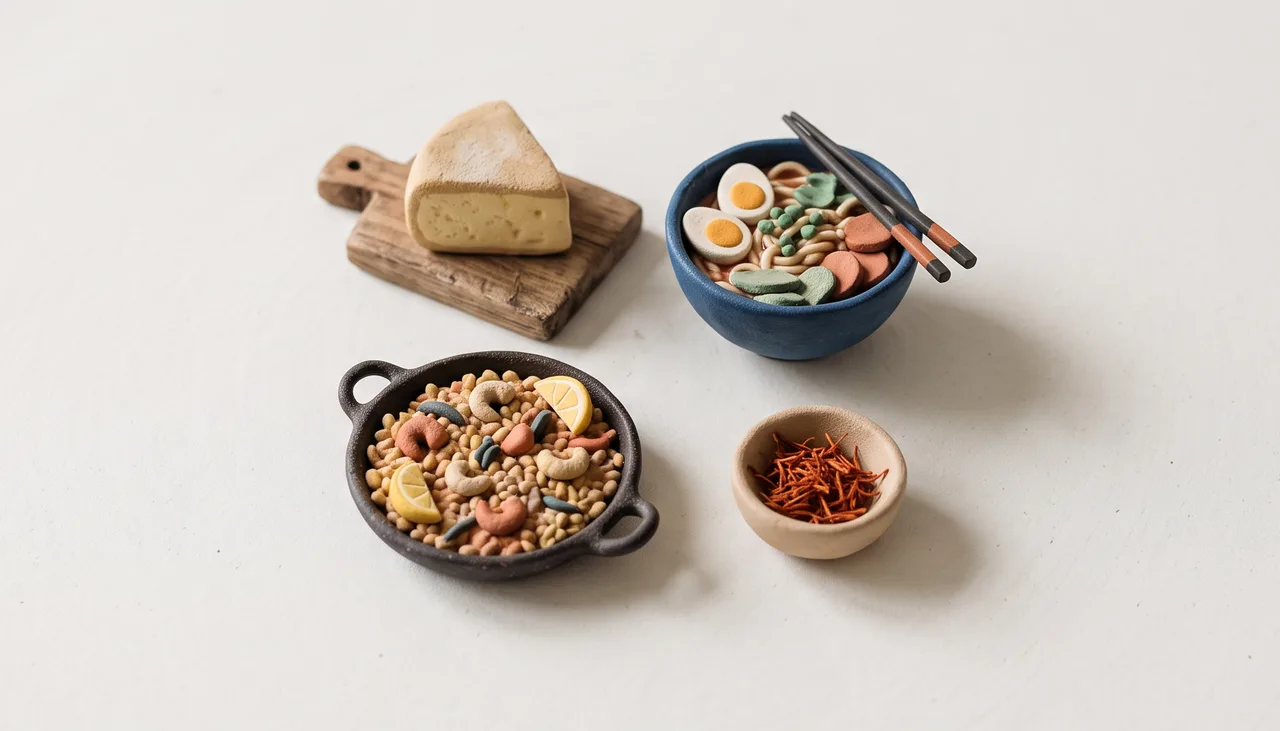
Cover illustration of the template “World food quiz”
Question 1 of 20

What is the main ingredient of guacamole?

What you can leave with

A quiz you can launch in a minute that makes everyone hungry, and leaves the group with verified food facts to share at the table.

All questions in this template

Open a question to see its answer, explanation and source. You can adapt the wording and order in the editor.

  1. 1. What is the main ingredient of guacamole?
    • Cucumber
    • Avocado
    • Green pepper
    • Celery

    Answer: Avocado

    Its name comes from Nahuatl, the Aztec language: ahuacamolli, from ahuacatl (avocado) and molli (sauce).

    Source: Online Nahuatl Dictionary (University of Oregon)

  2. 2. Which city’s pizza makers saw their craft added to UNESCO’s heritage list in 2017?
    • Naples
    • Rome
    • Milan
    • Venice

    Answer: Naples

    About 3,000 pizza makers work there. The dough is stretched with a rotating motion, then baked in a wood-fired oven.

    Source: UNESCO, Intangible Cultural Heritage

  3. 3. Roquefort cheese is made from which animal’s milk?
    • Cow
    • Goat
    • Buffalo
    • Sheep

    Answer: Sheep

    In 1925, it became France’s first cheese with a protected designation of origin. It ripens in caves dug beneath the village of Roquefort.

    Source: INAO (Institut national de l’origine et de la qualité)

  4. 4. Green tea and black tea come from the same plant.

    Answer: True

    Both come from the tea plant, Camellia sinensis. Black tea leaves are oxidized after picking; green tea leaves are not.

    Source: Harvard T.H. Chan School of Public Health, The Nutrition Source

  5. 5. Pho, a rice noodle soup in a fragrant broth, is an iconic dish of which country?
    • Thailand
    • Laos
    • Vietnam
    • Cambodia

    Answer: Vietnam

    It appeared in northern Vietnam over a century ago and became Hanoi’s signature dish, often eaten there for breakfast.

    Source: Vietnam National Authority of Tourism (vietnam.travel)

  6. 6. Saffron comes from the crocus flower. Which part of the plant is used?
    • Stigmas
    • Petals
    • Stamens
    • Bulb

    Answer: Stigmas

    Each flower has only three, picked by hand. It takes 70,000 to 200,000 flowers to make 1 kg (2.2 lb) of dried saffron.

    Source: UF/IFAS, University of Florida

  7. 7. Washoku, added to UNESCO’s heritage list in 2013, is the food culture of which country?
    • South Korea
    • China
    • Thailand
    • Japan

    Answer: Japan

    Washoku is built on respect for nature and local produce: grains, seafood, garden vegetables and wild plants.

    Source: UNESCO, Intangible Cultural Heritage

  8. 8. Which gas, produced by bacteria, creates the holes in Emmental cheese?
    • O₂
    • CO₂
    • N₂
    • CH₄

    Answer: CO₂

    But in 2015, Swiss researchers showed that tiny hay particles in the milk act as the starting points for the holes.

    Source: Agroscope (Swiss federal agricultural research), press release, 28 May 2015

  9. 9. In Brittany, which flour is traditionally used for galettes, the crêpes served as a main course?
    • Rye
    • Rice
    • Buckwheat
    • Chestnut

    Answer: Buckwheat

    Despite its name, buckwheat isn’t wheat or even a cereal: it’s a flowering plant, grown in Brittany since the Middle Ages.

    Source: Tourisme Bretagne

  10. 10. Most of a hot pepper’s heat comes from its seeds.

    Answer: False

    Capsaicin is made in the placenta, the white tissue that holds the seeds. The seeds only pick up heat by touching it.

    Source: New Mexico State University, Chile Pepper Institute (Circular 706)

  11. 11. Gazpacho, a soup served cold, comes from which region of Spain?
    • Catalonia
    • Galicia
    • Basque Country
    • Andalusia

    Answer: Andalusia

    It was first made with bread, garlic, vinegar and water. Tomato, which came from the Americas, was only added much later.

    Source: Real Academia de Gastronomía (Google Arts & Culture)

  12. 12. The Hungarian word gulyás, the origin of “goulash”, first referred to which job?
    • Butcher
    • Herdsman
    • Soldier
    • Miller

    Answer: Herdsman

    In Hungary, gulyás is first of all a soup: the “herdsman’s soup” of the cattle drovers of the Puszta, seasoned with paprika.

    Source: Smithsonian Folklife Festival

  13. 13. High in the mountains, water boils below 100 °C (212 °F).

    Answer: True

    Air pressure drops as you climb. In Denver, about 1,600 m (1 mile) up, water boils at roughly 94 °C (202 °F), so food cooks more slowly.

    Source: Pew Research Center

  14. 14. In Wolof, “ceebu jën”, the name of Senegal’s national dish, means “rice with…”
    • Fish
    • Chicken
    • Mutton
    • Duck

    Answer: Fish

    It was born in the fishing communities of Saint-Louis Island and has been on UNESCO’s heritage list since 2021.

    Source: UNESCO, nomination file 01748 (Ceebu jën)

  15. 15. The Maillard reaction, which browns bread crust, happens between sugars and…
    • Fats
    • Vitamins
    • Proteins
    • Minerals

    Answer: Proteins

    First described in 1912 by French chemist Louis-Camille Maillard, it also gives grilled meat and roasted coffee their aromas.

    Source: American Chemical Society (via Phys.org)

  16. 16. Carpaccio, created in a Venice bar in the 20th century, is named after a famous Venetian. Who was he?
    • A doge
    • A composer
    • An explorer
    • A painter

    Answer: A painter

    Vittore Carpaccio: the bright red of the raw beef recalled the reds in his paintings, then on show in Venice.

    Source: Store norske leksikon

  17. 17. To make tortillas, corn is traditionally cooked in water mixed with…
    • Salt
    • Slaked lime
    • Baking soda
    • Lime juice

    Answer: Slaked lime

    This is nixtamalization, a Mesoamerican technique: the lime loosens the kernels’ skins and greatly boosts the dough’s calcium.

    Source: FAO, Maize in human nutrition

  18. 18. Botanically, which of these plants is quinoa most closely related to?
    • Spinach
    • Rice
    • Lentil
    • Sunflower

    Answer: Spinach

    Quinoa isn’t a cereal but a “pseudo-cereal”, related to spinach and beets, and grown in the Andes for thousands of years.

    Source: UN News (United Nations)

  19. 19. On average, how much maple sap does it take to make 1 L of syrup?
    • 5 L
    • 10 L
    • 40 L
    • 200 L

    Answer: 40 L

    Sap is about 97% water, so it is boiled for hours to concentrate the sugar: roughly 40 gallons of sap per gallon of syrup.

    Source: Agriculture and Agri-Food Canada, “Canada’s Maple Syrup Industry” factsheet (archived by Library and Archives Canada)

  20. 20. Which country does the kiwifruit originally come from?
    • New Zealand
    • Australia
    • Chile
    • China

    Answer: China

    Once called the “Chinese gooseberry”, it was renamed kiwifruit in 1959 by New Zealand exporters, after the national bird.

    Source: Royal Horticultural Society

10 more world food questions

Read them aloud to keep the game going, or add them to the template. The answer follows each question.

UNESCO heritage

  • Which bread has been on UNESCO’s heritage list since 2022? — Answer: the baguette, made only from flour, water, salt and sourdough or yeast.
  • Which country’s “gastronomic meal” joined UNESCO’s list in 2010? — Answer: France; the meal has at least four courses, from starter to dessert.
  • According to UNESCO, what are the three pillars of traditional Mexican cuisine? — Answer: corn, beans and chili peppers.
  • Which country does tom yum kung, listed by UNESCO in 2024, come from? — Answer: Thailand; it’s a prawn soup with lemongrass and galangal.

Protected origin

  • What is the minimum ageing time for Parmigiano Reggiano? — Answer: 12 months; it is made from raw cow’s milk.
  • What is France’s only spice with a protected designation of origin? — Answer: Espelette pepper, grown in ten villages of the French Basque Country.
  • What is traditional balsamic vinegar of Modena PDO made from? — Answer: cooked grape must, aged at least 12 years in wooden barrels.

Gifts from the Americas

  • Where was the potato first domesticated? — Answer: in the Andes, in South America.
  • Where do chili peppers come from? — Answer: the Americas; they arose in South America, were domesticated notably in Mexico, and Christopher Columbus took some back to Spain.
  • Where was the pineapple domesticated? — Answer: in South America, probably in what is now Brazil.

How to run this activity

  1. 1

    Pick your format

    Play live on a big screen with everyone answering on their phone, or choose self-paced mode so each player goes at their own speed.

  2. 2

    Start the session

    Open the template, adjust the timer if needed, then share the PIN or QR code. Players join from their browser, with no app to install.

  3. 3

    Vote, then share stories

    After each vote, the explanation appears. Take a few seconds to discuss it: it’s the perfect moment for travel and kitchen memories.

  4. 4

    Finish strong

    Reveal the podium, then ask which answer surprised people most. Add a question about a family recipe for a rematch.

Make this activity yours

Keep what fits, rewrite what does not and set the pace for your group.

Use this template

Templates are included in the free plan. Participation limits depend on your plan. See plans.