
A good club sports quiz mixes the sections, stays away from lists of winners and takes less than an hour. Ask about rules, measurements and stories: they can be reasoned out, and a judo beginner can beat a football specialist. The point is to get people talking, not to crown the biggest fan.
The end of the season, an annual meeting or a welcome evening all work well. The quiz gives the evening a rhythm and brings together members who never share the same field.
Worked example
An evening in four rounds
See the explanation
The referee reads the rule in the prepared source and the game goes on. If the question was ambiguous, cancel it for everyone.
Write down the disputed question: once reworded, it will be useful next time.
Open the template · Sports quiz: 20 questions with answers
Build balanced teams
Draw teams of three to five people, with at least two different sports in each. Give them two minutes to find a name. A team that has just chosen its name together already answers better together.
Appoint a referee who does not play. This person reads the questions, keeps the source at hand and states the rule when in doubt. A disputed answer is settled in ten seconds when the source is ready.
One hour, four rounds
Short rounds leave time to order drinks and to comment on the answers.
- Five minutes: draw the teams and play a practice question.
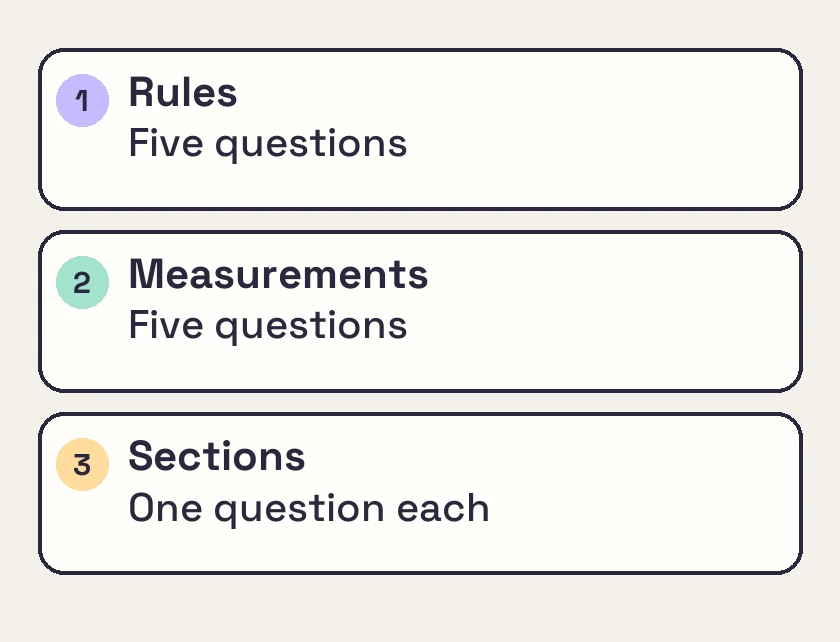
- Ten minutes: rules, five questions.
- Ten minutes: measurements, five questions.
- Ten minutes: break.
- Ten minutes: true or false, five statements.
- Ten minutes: each section asks the others a question.
Twelve questions ready to ask
They come from the twenty-question quiz that goes with this guide. The answers were checked in the sources listed at the bottom of the page.
| Question | Answer | What to say next |
|---|---|---|
| How many rings are in the Olympic symbol? | 5 | Designed by Pierre de Coubertin in 1913, they stand for the union of the five continents. |
| Which city hosted the first modern Olympic Games, in 1896? | Athens | A Greek, Spyridon Louis, won the marathon. Winners received a silver medal and an olive branch. |
| A marathon is exactly 40 kilometers long. | False | The distance (26.2 miles) goes back to the 1908 London Games: from Windsor Castle to the royal box in the stadium. |
| In rugby union, how many points is a try worth? | 5 | A conversion adds two; a penalty kick or drop goal is worth three. A try was worth only four until 1992. |
| In which sport do you hit a shuttlecock? | Badminton | Competition shuttlecocks have 16 feathers. On a smash, they fly well over 300 km/h (190 mph). |
| How high is an official basketball hoop? | 3.05 m (10 ft) | That was the height of the gym balcony where James Naismith hung the first baskets in 1891. |
| In volleyball, the libero wears a different shirt from their teammates. | True | This defensive specialist may not attack above the net and, under international rules, may not serve. |
| In the Tour de France, who wears the polka dot jersey? | The best climber | It dates from 1975. The overall leader wears the yellow jersey, introduced in 1919. |
| What rock are curling stones made of? | Granite | Those used at the Olympics come from Ailsa Craig, a small Scottish island. Each stone weighs almost 20 kg (44 lb). |
| In foil fencing, the whole body is a valid target. | False | In épée, the whole body counts, head to toe. In sabre, the target is above the waist. |
| Olympic gold medals are solid gold. | False | They are made of silver, plated with at least 6 grams of gold. The last solid gold ones date from 1912. |
| Tug of war used to be an Olympic event. | True | In 1908, British teams took all three medals: police squads from London and Liverpool. |
Have each section write a question
The last round belongs to the club. Each section prepares a question about its discipline, with the answer and the place where it can be checked. It is the liveliest moment of the evening, and the most instructive: people discover the rules of the others. Read the questions beforehand to remove those with two answers.
Three common mistakes
They lose part of the room.
- Recent winners: they change every season and always favour the same people.
- Records without a date: a record gets beaten, so state the day you checked it.
- The speed bonus: younger members read more slowly, so remove it or play in teams.
Play it with Pomlet in 5 steps
Everything above works on paper. A projected session saves you from counting points by hand. The names in quotation marks are the ones on screen.
- Start from the template: in your library, choose “Create session”, then “Choose a template”. Open “Sports quiz: rules and surprises” and select “Use this template”.
- Adapt it: keep the questions that suit your group, change their order and add your own. The copy is yours.
- Set the pace: with small children, set “Time limit” to “No time limit” and close each question yourself with “End question”.
- Launch: choose “Play”, then “Classic” under “Live”. Everyone joins with the QR code or the PIN, with no app to install.
- Comment: after each question, the explanation is shown. Leave ten seconds for reactions before moving on.
The Free plan takes up to 8 participants per session. In a larger group, one phone per team is enough.
A prize for everyone
Give a small prize to the best team and another to the best section question. Two ways to win are better than one. The related template contains twenty questions about the rules, the measurements and the surprises of sport.
Useful links
Sources and further reading
- How many rings are in the Olympic symbol – Wikipedia
- Which city hosted the first modern Olympic Games, in 1896 – Olympedia
- A marathon is exactly 40 kilometers long – World Athletics
- In rugby union, how many points is a try worth – Wikipedia
- In which sport do you hit a shuttlecock – Wikipedia
- How high is an official basketball hoop – Springfield College
- In volleyball, the libero wears a different shirt from their teammates – FIVB Official Rules 2025–2028
- In the Tour de France, who wears the polka dot jersey – Wikipedia
- What rock are curling stones made of – World Curling
- In foil fencing, the whole body is a valid target – Wikipedia
- Olympic gold medals are solid gold – Wikipedia
- Tug of war used to be an Olympic event – Olympedia