
A team quiz is one of the simplest ways to get colleagues talking to people outside their usual circle. A big screen, everyone’s phone and twenty minutes are enough to turn a seminar, an all-hands meeting or the end-of-year party into a shared moment, where sales discover what the warehouse knows and the newest colleague can win a round.
It only works if nobody feels tested, exposed or left out. This guide gives you round ideas for the usual occasions, a simple way to form fair teams and the golden rules that keep a quiz at work short, inclusive and kind.
Worked example
Rotate speaking roles in a team
See the explanation
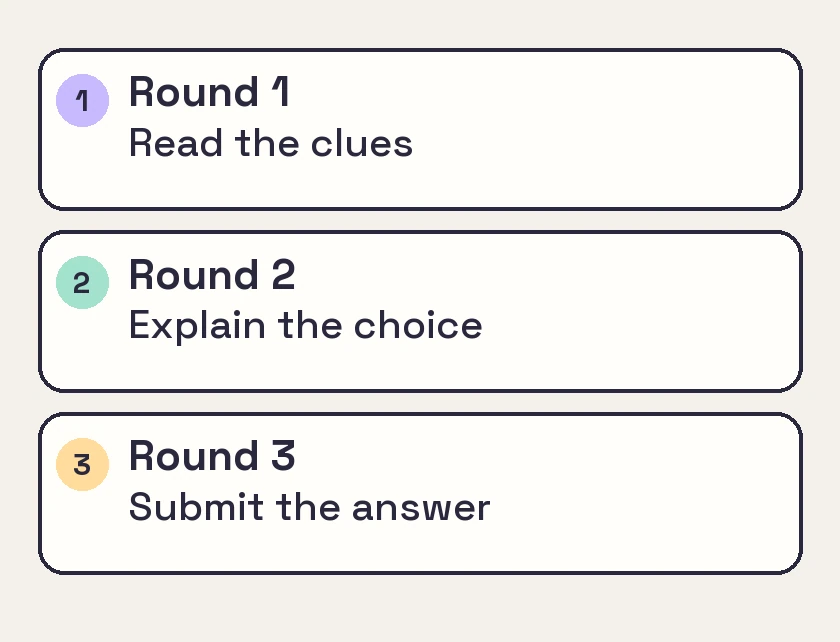
Assign three roles before play. Rotate them after each question. The person explaining must name the decisive clue before the person holding the phone submits.
Open the template · Team onboarding: a first-week check-in template
Start from the occasion
The same quiz does not fit every moment. During onboarding week, it helps newcomers find their bearings; at a seminar, it brings the energy back after a long morning of talks; at an all-hands meeting, it makes two or three key messages stick; at the end-of-year party, it is simply there for fun. Decide what the quiz is for before you write a single question.
For a newcomer’s first-week conversation about access, priorities and people to meet, use our onboarding check-in template. The team quiz is the lighter, collective moment that comes alongside it: newcomers play with long-standing colleagues and learn without ever being tested alone.
- Onboarding week: 10 to 15 questions about the company, in teams that mix newcomers and veterans
- Seminar or offsite: a 20-minute quiz to open the second day or to restart after lunch
- All-hands meeting: four or five questions about the year’s projects, between two presentations
- End-of-year party: three short rounds between courses, including a festive one
- Remote or hybrid team: a ten-minute quiz at the start of the monthly call
Round 1: the company and its products
Questions about your own organisation work best when they reveal stories rather than test knowledge of the org chart. Ask about milestones, products, places and the habits that make the company what it is, and write the story behind each answer in the explanation shown after the answer (up to 300 characters). That is where newcomers actually learn something.
- In which year did the company open its first office, and where?
- Put these product launches in order, from the oldest to the newest
- Which of these four products was almost called something else?
- What does this internal acronym really stand for?
- How many cups of coffee does the office machine serve in a normal week?
Check every answer with someone who knows: finance for figures, communications for dates. A wrong “official” answer in front of the whole company is hard to take back.
Round 2: your industry and your trade
A round about your sector gives specialists from every department a chance to shine: engineers know the technical terms, customer service knows what clients ask, logistics knows the orders of magnitude. Mix common myths as true or false questions, single-choice questions with plausible wrong answers and a ranking of process steps.
- True or false: a common belief about your industry, with the facts in the explanation
- Which of these four terms is not real jargon in our field?
- Put the steps of an order, a project or a production run in the right order
- Which tool did the team use before the current one?
Round 3: general knowledge everyone can play
General knowledge levels the field: the intern can beat the director. Choose international topics over one country’s pop culture, pictures over long sentences, and a gentle level of difficulty. A sound round works well too: record the office noises yourself (the printer, the lift, the coffee machine) and add them as short audio excerpts that play on the host screen.
For the end-of-year party, borrow a festive round from our 40-question Christmas quiz, and add one question about the year the team has just lived through.
Questions about colleagues, only with consent
Rounds about colleagues are often the most popular and the most delicate. Ask for volunteers in advance, let each person choose the fact they share and let them reread the question before the event. Anyone can say no without explaining why, and the question must not reveal anything they did not approve.
Keep to harmless facts that people chose: a first job, a sport, a city they lived in, a hidden talent. Leave out health, family, religion, politics, salary and appearance, and never take photos from someone’s private social media. If you want to use childhood photos or other personal material, check with HR or the person in charge of data protection in your company how to collect it and when to delete it.
A simple test: would this colleague happily tell the story to the whole room? If not, leave the question out.
Form fair teams
Teams of three to six people give everyone a say and take the pressure off individuals. Mix departments, sites, seniority and languages so that the quiz connects people who rarely work together. In a hybrid meeting, avoid setting the room against the remote colleagues: mix both in each team and give every team a chat thread to confer.
In Pomlet’s Teams mode, you create the teams yourself or prepare team names that players pick when they join, for example one per table or per site. You can shuffle players at random or drag them from one team to another. The team score is either the sum of every member’s points or “Best answer counts”: only each team’s best gain on each question counts, so a team of three can compete fairly with a team of seven.
- Size: three to six people per team
- Mix: departments, sites, seniority and languages
- Names: playful team names, or one per table or site
- Scoring: “Best answer counts” when team sizes differ, “All points count” when they are equal
Golden rules for a quiz everyone enjoys
A quiz at work brings together people who will see each other again on Monday. In a 1999 study of 51 work teams in a manufacturing company, Amy Edmondson found that teams whose members felt safe taking interpersonal risks showed more learning behaviour, such as asking questions, seeking feedback and discussing errors, and that this behaviour went with better team performance. A quiz will not create that climate on its own, but it should never work against it.
- Short: 15 to 25 minutes, three or four rounds and a clear ending
- Inclusive: questions that every department and every site can answer
- Accessible: large, readable text, questions read aloud and enough time to answer
- No humiliation: nothing that singles someone out, no jokes about wrong answers
- Language-neutral: plain sentences, no puns, idioms or very local references
- Not an evaluation: results show who had fun, not who is good at their job
Competition, yes, but with collaboration
Points and a leaderboard add energy, but research suggests keeping them light. A 2020 meta-analysis of gamification in learning by Sailer and Homner found small positive effects overall; for learning behaviour, designs that combined competition with collaboration worked particularly well, although few studies were available for each type. In a 16-week university course studied by Hanus and Fox in 2015, students in the version with a leaderboard and badges ended the term less motivated and less satisfied, and scored lower on the final exam, than students in the same course without them.
Neither study looked at quizzes at work, so take them as a direction rather than a rule: let teams compete rather than individuals, and make sure the ranking no longer matters once the game is over. Symbolic prizes work well: a silly trophy that travels from team to team, the right to choose the next quiz theme, or simply applause.
In Pomlet, the host screen shows the top 5 between questions by default and a podium of the top 3 at the end; in Teams mode, the leaderboard ranks teams. You can hide each player’s score and rank during the game so that they only appear at the end, and switch off the speed bonus, which is on by default and gives more points for faster answers.
Set up the quiz in Pomlet
Create a session, write your rounds and launch it live in Teams mode. Colleagues join from their phone or computer with the QR code, the PIN or a link, without installing an app or creating an account, and choose a nickname. For a seminar, prepare the session in advance: the same PIN and QR code are reserved for 7 or 30 days, so you can print them in the programme.
- Questions: single choice, true or false, ranking for milestones, a poll for opinion questions
- Time: a time limit per question, or “No time limit” if you prefer to end each question yourself
- Speed: switch off the speed bonus when reading speed should not decide the winner
- Remote colleagues: share your screen in the video call and post the join link in the chat
- Group size: up to 8 participants per session on the Free plan, up to 1,000 with Pro
- Several time zones: a self-paced session lets everyone answer individually, without a timer, before a deadline you choose
Let a newcomer verify the answer
Replace “Who always arrives first?” with “Where can a new colleague find the meeting room booking rules?” Give teams a minute to locate the current instruction. Accept the path that works today and change the answer key if the team moved the page. The newcomer leaves with a usable bookmark.
Ready for your next team moment
A good quiz at work is short, kind and full of real stories. Choose the occasion, mix three kinds of rounds, form mixed teams, and check every answer and every personal question before the day.
If you are welcoming new colleagues, pair the quiz with a first-week check-in; if the group needs to warm up first, open with a few icebreaker questions. Then let the teams play, and stop while everyone is still smiling.
Useful links
Sources and further reading
- Edmondson (1999), Psychological safety and learning behavior in work teams – Administrative Science Quarterly
- Sailer & Homner (2020), The gamification of learning: a meta-analysis – Educational Psychology Review
- Hanus & Fox (2015), Assessing the effects of gamification in the classroom: a longitudinal study – Computers & Education