
Quiz / session

Dog and cat quiz: 20 questions with answers

Do cats always land on their feet? Which country sent the first cat into space? This dog and cat quiz brings together 20 questions for animal lovers: breeds, senses, behavior, domestication and common myths. The first questions are easy, the last ones trickier. Every answer is explained and sourced, and the leaderboard updates live.

Time including discussion:
15–20 min
For:
Families, dog and cat owners, teachers, clubs and community groups, game nights with friends

English template · 20 questions · Updated on

Use this template

Make your own copy and edit it. Sign in or create an account to open it in the editor.

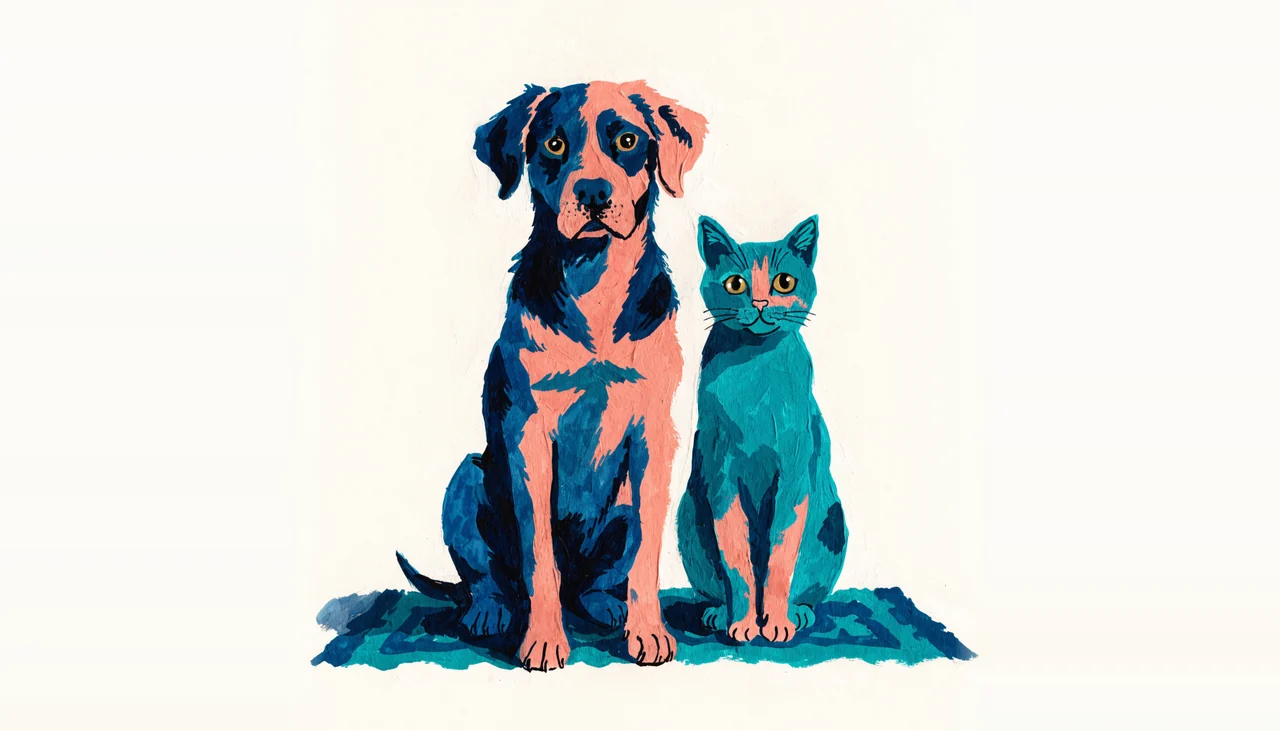
Cover illustration of the template “Dog and cat quiz: 20 questions”
Question 1 of 20

Which wild animal is the dog’s closest living relative?

What you can leave with

A quiz ready in a minute, packed with surprising facts about our four-legged friends, with verified answers.

All questions in this template

Open a question to see its answer, explanation and source. You can adapt the wording and order in the editor.

  1. 1. Which wild animal is the dog’s closest living relative?
    • Red fox
    • Gray wolf
    • Golden jackal
    • Coyote

    Answer: Gray wolf

    But dogs don’t descend from today’s wolves: both come from an ancient wolf population that has since died out.

    Source: Wikipedia, Domestication of the dog (synthèse d’études génétiques)

  2. 2. Cats always land on their feet.

    Answer: False

    Their righting reflex often helps, but they need time to turn over: a very short fall or excess weight can stop them.

    Source: VCA Animal Hospitals

  3. 3. Which ancient Egyptian goddess was shown with the head of a cat?
    • Isis
    • Hathor
    • Nut
    • Bastet

    Answer: Bastet

    Her great sanctuary was at Bubastis, in the Nile Delta, where large numbers of mummified cats have been found.

    Source: Wikipedia, Bastet

  4. 4. A purring cat is always a happy cat.

    Answer: False

    Cats also purr when stressed, at the vet for example, or when in pain: purring may help them soothe themselves.

    Source: Cats Protection (Royaume-Uni)

  5. 5. What color is a Dalmatian puppy’s coat at birth?
    • Plain white
    • Plain black
    • Plain gray
    • Spotted

    Answer: Plain white

    The first spots appear at around 2 weeks old, and they keep developing for more than a year.

    Source: American Kennel Club

  6. 6. Why does a cat sometimes pull a face, mouth half open, after sniffing something?
    • It’s disgusted
    • It’s cooling down
    • It’s analyzing the scent
    • It’s warning a rival

    Answer: It’s analyzing the scent

    This expression sends the scent through a small duct in the roof of the mouth to an organ that is highly sensitive to pheromones, animals’ chemical messages.

    Source: PetMD (contenu relu par des vétérinaires)

  7. 7. Dogs sweat through the pads of their paws.

    Answer: True

    But it cools them only a little: to shed heat, dogs rely mainly on panting with their tongue out.

    Source: American Kennel Club

  8. 8. On which island was a cat found buried beside a human 9,500 years ago?
    • Cyprus
    • Crete
    • Sicily
    • Malta

    Answer: Cyprus

    Cats weren’t native to the island, so people had brought them from the mainland, long before the Egypt of the pharaohs.

    Source: ScienceDaily (communiqué sur l’étude publiée dans Science, 2004)

  9. 9. How long does a dog’s pregnancy last on average?
    • About 1 month
    • About 2 months
    • About 4 months
    • About 6 months

    Answer: About 2 months

    About 63 days after ovulation. Counted from the first mating, it ranges from 58 to 72 days.

    Source: American Kennel Club

  10. 10. Adult cats hardly ever meow at each other.

    Answer: True

    Kittens meow to call their mother. As adults, cats keep this sound mostly for humans.

    Source: ASPCA

  11. 11. What breed was Hachikō, the dog who waited for his owner at Shibuya Station for almost 10 years?
    • Shiba Inu
    • Tosa Inu
    • Hokkaido Inu
    • Akita Inu

    Answer: Akita Inu

    His owner, Professor Ueno, died suddenly in 1925. Yet Hachikō kept coming back to the station to wait for him, day after day.

    Source: Nippon.com

  12. 12. Why are a Siamese cat’s ears, paws and tail darker than its body?
    • The sun darkened them
    • The fur is denser there
    • Those parts are cooler
    • More blood flows there

    Answer: Those parts are cooler

    Its pigment only forms where the skin is cooler. Kittens, kept warm inside their mother, are therefore born white.

    Source: National Geographic

  13. 13. The rescue dogs of the Great St Bernard Pass carried a little barrel of brandy around their necks.

    Answer: False

    The image comes mainly from an 1820 painting by English artist Edwin Landseer. The barrel on the famous Barry, in Bern, was added later.

    Source: SRF (radio-télévision suisse alémanique) sur l’exposition Barry du Musée d’histoire naturelle de Berne

  14. 14. In which country did the hairless cat breed called the Sphynx begin?
    • Egypt
    • Canada
    • Mexico
    • Thailand

    Answer: Canada

    It began in Toronto in 1966 with Prune, a hairless kitten. The name suggests Egypt, but the breed is recent.

    Source: VCA Animal Hospitals

  15. 15. Which dog breed is famous for hardly ever barking?
    • Beagle
    • Pug
    • Jack Russell
    • Basenji

    Answer: Basenji

    Originally from the Congo rainforests, it has an unusually shaped larynx: instead of barking, it makes a kind of yodel.

    Source: American Kennel Club

  16. 16. Which small feline are our pet cats descended from?
    • African wildcat
    • Sand cat
    • Pallas’s cat
    • Fishing cat

    Answer: African wildcat

    A large genetic study in 2007 showed it: our house cats are very closely related to wildcats from the Near East.

    Source: National Geographic (étude Driscoll et al., Science, 2007)

  17. 17. How many teeth does an adult dog have?
    • 28
    • 32
    • 42
    • 52

    Answer: 42

    That’s ten more than us, as we usually have 32. An adult cat has only 30.

    Source: VCA Animal Hospitals

  18. 18. Cats lack a working taste receptor for sweetness.

    Answer: True

    A key gene for this receptor is broken in cats, just as in tigers and cheetahs, all strict meat-eaters.

    Source: PLoS Genetics (Li et al., 2005)

  19. 19. Which dog breed is known for its blue-black tongue?
    • Samoyed
    • Chow Chow
    • Alaskan Malamute
    • Keeshond

    Answer: Chow Chow

    This dog from China shares the trait with another Chinese breed, the Shar Pei. Ideally, its mouth is black too.

    Source: FCI, standard n° 205 du chow-chow

  20. 20. In 1963, which country sent the first cat into space?
    • USSR
    • United States
    • United Kingdom
    • France

    Answer: France

    Félicette made a 13-minute flight above the Sahara and came back unharmed. A statue honors her near Strasbourg.

    Source: Guinness World Records

10 more questions about dogs and cats

Read them aloud to keep the game going, or add them to the template. The answer follows each question.

Famous dogs

  • Which animal was the first to orbit the Earth, in 1957? — Laika the dog, aboard Sputnik 2.
  • How many lives are the Great St Bernard hospice and its dogs thought to have saved? — More than 2,000, by estimates.
  • Which dog tracks so well that its results have been accepted in court? — The Bloodhound.

Bodies and senses

  • What color are most kittens’ eyes when they first open them? — Blue: their adult color develops over the first few months.
  • Why are calico and tortoiseshell cats almost always female? — The coat requires two X chromosomes.
  • About how many scent receptors does a Bloodhound have? — Around 230 million, some 40 times more than us.
  • At what age does a kitten open its eyes? — At around two weeks.

History and myths

  • Is one dog year worth seven human years? — No: a medium-sized dog’s first year equals about 15 human years.
  • Which country does the waving lucky cat come from? — Japan: it’s the maneki-neko.
  • How many lives does a cat have in German sayings? — Seven, as in French and often Spanish, rather than nine as in English.

How to run this activity

  1. 1

    Pick your format

    Play live: show the questions on a screen while everyone answers on their phone and Pomlet keeps score. In class, the Self-paced mode lets everyone play in their own time, with no timer.

  2. 2

    Start the session

    Open the template, adjust the timer if needed, then share the PIN or QR code. Players join from their browser, with no app to install.

  3. 3

    Vote, then explain

    After each vote, the explanation appears. Let owners share what they notice in their own dog or cat.

  4. 4

    Finish on the podium

    Reveal the podium, then ask which answer surprised everyone most. For a rematch, pit team dog against team cat.

Make this activity yours

Keep what fits, rewrite what does not and set the pace for your group.

Use this template

Templates are included in the free plan. Participation limits depend on your plan. See plans.