
Quiz / session

Toys and games quiz: 20 questions with answers

How many tiles are in a domino set? Which country was the bellhop who started the yo-yo craze from? This toys and games quiz takes you back in time, from ancient boards to the school playground. Knucklebones, dominoes, playing cards, yo-yos and chess: 20 multiple-choice questions, each followed by a fact-checked explanation. Everyone answers on their phone and the leaderboard updates live.

Time including discussion:
15–20 min
For:
Families, grandparents and grandchildren, teachers, game nights with friends, teams and facilitators

English template · 20 questions · Updated on

Use this template

Make your own copy and edit it. Sign in or create an account to open it in the editor.

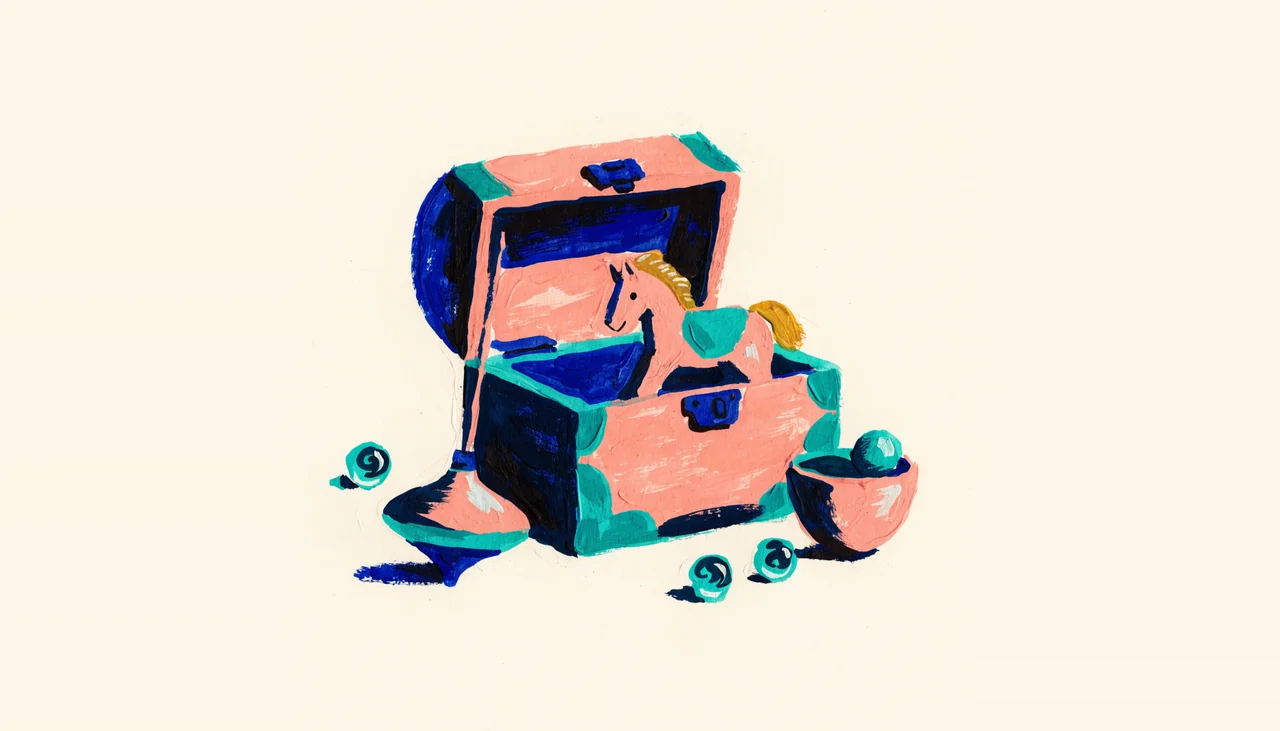
Cover illustration of the template “Old-time toys and games quiz”
Question 1 of 20

In 1902, Theodore Roosevelt refused to shoot an animal tied to a tree. A famous toy followed. Which animal?

What you can leave with

A quiz ready in a minute, nostalgic and light-hearted, that brings back childhood memories and reveals the history of timeless games.

All questions in this template

Open a question to see its answer, explanation and source. You can adapt the wording and order in the editor.

  1. 1. In 1902, Theodore Roosevelt refused to shoot an animal tied to a tree. A famous toy followed. Which animal?
    • A deer
    • A bear
    • A wolf
    • A rabbit

    Answer: A bear

    It happened on a hunt in Mississippi. A Brooklyn candy-shop owner, Morris Michtom, then made a stuffed “Teddy’s Bear”, after the president’s nickname.

    Source: National Park Service (Theodore Roosevelt Birthplace)

  2. 2. On a standard six-sided die, what do two opposite faces add up to?
    • 4
    • 5
    • 6
    • 7

    Answer: 7

    Many Roman dice already followed this rule. In the Netherlands, medieval dice often paired 1-2, 3-4 and 5-6, until the rule of 7 took over around 1450.

    Source: UC Davis (étude de 110 dés des Pays-Bas, Eerkens et de Voogt)

  3. 3. Senet, one of the oldest known board games, was played in which civilisation?
    • Ancient Egypt
    • Ancient Greece
    • Ancient Rome
    • Ancient China

    Answer: Ancient Egypt

    Tutankhamun took senet boards into his tomb. One of them, now in the Cairo museum, hides a second 20-square game on its back.

    Source: Global Egyptian Museum (Egyptian Museum, Cairo, JE 62058)

  4. 4. How many pieces make up a tangram, the famous Chinese puzzle?
    • 5
    • 6
    • 7
    • 9

    Answer: 7

    Around 1800, a Chinese book of hundreds of figures started the craze. It reached England, then France and Denmark in 1817 and 1818.

    Source: UNSW Sydney

  5. 5. Snakes and Ladders comes from a traditional game from which country?
    • China
    • Japan
    • India
    • Egypt

    Answer: India

    The ladders stood for virtues and the snakes for vices. The British brought the game home from India in the 19th century.

    Source: Victoria and Albert Museum

  6. 6. Ancient knucklebones were real sheep bones. Which part of the animal did they come from?
    • Knee
    • Ankle
    • Tail
    • Jaw

    Answer: Ankle

    This bone, the astragalus, has very different sides, perfect for games. Greeks and Romans played with them, especially children and young Greek women.

    Source: Pitt Rivers Museum, University of Oxford

  7. 7. How many tiles are there in a standard domino set, from double blank to double six?
    • 21
    • 24
    • 26
    • 28

    Answer: 28

    China had dominoes by the 12th century. In Europe they appear in the 18th century, probably in Italy, and nobody knows if they came from China.

    Source: Pagat.com (John McLeod, d’après Michael Dummett)

  8. 8. In the 1920s, a hotel bellhop started the yo-yo craze in California. Which country was he from?
    • Philippines
    • Mexico
    • Indonesia
    • Guatemala

    Answer: Philippines

    Pedro Flores played with yo-yos on his breaks, then began making them. The toy is far older: it appears on ancient Greek pottery.

    Source: The Strong National Museum of Play (National Toy Hall of Fame)

  9. 9. How many lines run along each side of a standard Go board?
    • 19
    • 20
    • 21
    • 24

    Answer: 19

    These lines cross at 361 points, where the black and white stones are placed. Go was born in China more than 2,000 years ago.

    Source: Nihon Ki-in (fédération japonaise de go)

  10. 10. In which country were the hearts, diamonds, clubs and spades suits born, in the 15th century?
    • Italy
    • Spain
    • France
    • Germany

    Answer: France

    French card makers created them in the late 15th century. Hearts and spades probably came from the hearts and leaves of German cards.

    Source: International Playing-Card Society

  11. 11. In 18th-century London, what did the wooden puzzles that led to today’s jigsaws show?
    • Royal portraits
    • Geographical maps
    • Farm animals
    • Alphabet letters

    Answer: Geographical maps

    Engraver John Spilsbury mounted maps on wood and cut them along the borders, so children learned geography as they played.

    Source: London Museum

  12. 12. In which present-day country did archaeologist Leonard Woolley unearth the Royal Game of Ur?
    • Turkey
    • Greece
    • Jordan
    • Iraq

    Answer: Iraq

    It comes from the Royal Cemetery at Ur, in southern Iraq. This two-player race game dates from about 2600 to 2400 BC.

    Source: British Museum (via Google Arts & Culture)

  13. 13. How many squares are there on the classic Game of the Goose track?
    • 63
    • 64
    • 72
    • 100

    Answer: 63

    An Italian sermon mentions it as early as the 15th century. The oldest known dated copy was printed in Rome in 1598.

    Source: Magdalene College, Cambridge (Pepys Library)

  14. 14. The 48 Japanese hanafuda cards form 12 suits of 4. What does each suit stand for?
    • A zodiac animal
    • A month of the year
    • A Japanese island
    • An hour of the day

    Answer: A month of the year

    Hanafuda means “flower cards”: pine for January, cherry blossom for March. They grew out of cards brought by the Portuguese in the 16th century.

    Source: Ohio State University, East Asian Studies Center

  15. 15. In international draughts, on a 100-square board, how many pieces does each player start with?
    • 12
    • 15
    • 16
    • 20

    Answer: 20

    Here, ordinary pieces can capture backwards as well as forwards, and a king flies along a diagonal over as many empty squares as it likes.

    Source: World Mind Games

  16. 16. Mamluk cards from Egypt, ancestors of ours, had a suit of sticks from which sport?
    • Hockey
    • Golf
    • Polo
    • Cricket

    Answer: Polo

    Their suits were cups, coins, swords and polo sticks. As polo was unknown in Europe, the sticks became sceptres, batons or cudgels.

    Source: International Playing-Card Society

  17. 17. In early chess, before it became the queen, what did this piece represent?
    • An elephant
    • A war chariot
    • A horseman
    • An advisor

    Answer: An advisor

    It was called the “fers”, after the vizier. It moved just one square diagonally, before becoming the strongest piece in the late Middle Ages.

    Source: Medievalists.net

  18. 18. Roughly what does the word “kaleidoscope”, coined by David Brewster around 1816, mean in Greek?
    • Turning the light
    • Seeing beautiful shapes
    • Mirror of colours
    • Looking far away

    Answer: Seeing beautiful shapes

    Kalos (beautiful), eidos (shape), skopein (to look): the Scottish physicist patented his mirror tube in 1817, and it soon became a toy.

    Source: EBSCO Research Starters

  19. 19. What are the Lewis chessmen, found in Scotland, mostly carved from?
    • Elephant ivory
    • Boxwood
    • Walrus ivory
    • Deer antler

    Answer: Walrus ivory

    A few pieces are made of whale tooth. Found at Uig, on the Isle of Lewis, in circumstances that remain unclear, they are thought to come from Norway.

    Source: Vikingeskibsmuseet (Musée des navires vikings, Roskilde)

  20. 20. In 15th-century Italy, what was tarot first used for?
    • Playing card games
    • Telling fortunes
    • Learning to read
    • Keeping accounts

    Answer: Playing card games

    It was a trick-taking game, with trumps called “triumphs”. Using tarot to tell fortunes only spread from the late 18th century.

    Source: Victoria and Albert Museum

10 more questions about old-time toys and games

Read them out loud to keep the game going, or add them to the template. The answer follows each question.

Toys from around the world

  • How many dolls were in the very first matryoshka, painted by Sergey Malyutin? — Eight, nested one inside the other.
  • In late 18th-century Japan, who played kendama? — Adults, as a social game in taverns; it only became a children’s toy later.
  • In which part of Japan was the modern kendama, with its cup crosspiece, born? — Hiroshima Prefecture, in the late 1910s.

Puppets and outdoor games

  • In which city was the puppet Guignol born, around 1808? — Lyon, in France.
  • What was the first trade of Laurent Mourguet, Guignol’s creator? — Silk weaver, a “canut” in Lyon.
  • Where does the name “pétanque” come from? — From Provençal: you throw the ball with your foot planted on the ground like a stake.

Boards and cards

  • How many squares are there on a senet board? — Thirty.
  • How many pits does a classic mancala board, such as oware, have? — Twelve, in two rows of six, for 48 seeds.
  • How many cards are there in a tarot deck? — 78: 21 trumps, the Fool (or Excuse) and 56 suit cards.
  • When did playing cards from the Islamic world reach southern Europe? — In the second half of the 14th century: the first reliable mentions date from the 1370s.

How to run this activity

  1. 1

    Choose your format

    Play out loud without phones: read each question and let the group answer. Or import the template: everyone answers on their phone and Pomlet keeps score.

  2. 2

    Start the session

    Open the template, adjust the timer if needed, then share the PIN or the QR code. Participants join from their browser, with no app to install.

  3. 3

    Vote, then tell the story

    After each vote, the explanation appears. Leave room for memories: everyone has a domino game or a yo-yo story to share.

  4. 4

    Finish on the podium

    Reveal the podium, then ask which childhood game everyone would bring back from the attic. Add a question about your family’s favourite game for the rematch.

Make this activity yours

Keep what fits, rewrite what does not and set the pace for your group.

Use this template

Templates are included in the free plan. Participation limits depend on your plan. See plans.