
A forty-question quiz takes about an hour with explanations, and an hour and a half with two breaks. Split it into four rounds of ten, mix the topics within each round and announce the score halfway. The difficulty should rise and fall, so that nobody drops out before the end.
This format suits an evening, a family party or the last day before a vacation. For a lunch break, take twenty questions instead.
Worked example
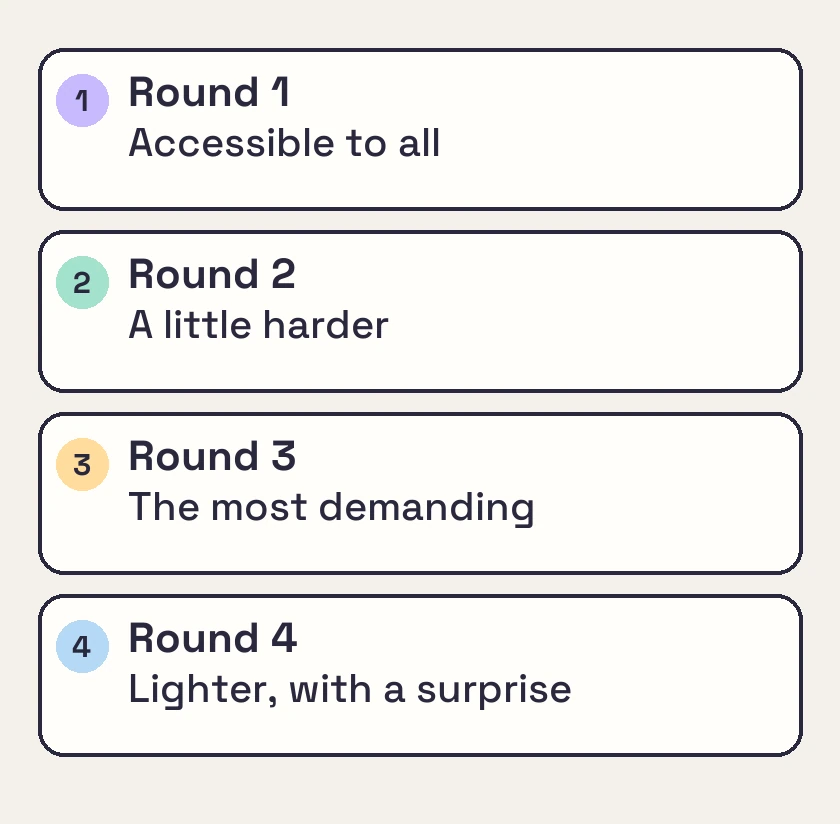
Four rounds of ten
See the explanation
Take a short break and announce a round in which points count double. Then ask an easy question to restart.
Next time, move the break before the most demanding round.
Open the template · General knowledge quiz: 40 questions, answers
Work out the length
Allow a minute and a half per question: read, think, reveal, comment. Forty questions therefore take an hour. Add ten minutes to settle in and fifteen minutes of breaks. If you have less time, remove questions; do not read faster.
Prepare three spare questions too. A disputed question can be replaced, and a tie can be settled without improvising.
The plan for the evening
Four rounds, four colors: each one mixes the subjects.
- Ten minutes: welcome, nicknames and a practice question.
- Fifteen minutes: questions 1 to 10, the most accessible.
- Fifteen minutes: questions 11 to 20, then the scores.
- Fifteen minutes: break.
- Fifteen minutes: questions 21 to 30, the most demanding.
- Fifteen minutes: questions 31 to 40, lighter, and the prize.
Twelve questions ready to ask
They come from the forty-question quiz that goes with this guide. The answers were checked in the sources listed at the bottom of the page.
| Question | Answer | What to say next |
|---|---|---|
| Which gas do plants take in for photosynthesis? | Carbon dioxide | With water and light, they turn it into sugars and release oxygen. |
| The Louvre is a museum in Rome. | False | Once a fortress, then a royal palace, it became a museum in 1793. The glass pyramid dates from 1989. |
| Who wrote “Romeo and Juliet”? | William Shakespeare | The play dates from the 1590s and is set in Verona, Italy. |
| Which planet is closest to the Sun? | Mercury | With almost no atmosphere, it swings from about 430 °C by day to −180 °C at night. |
| Diamond is the hardest mineral on the Mohs scale. | True | Talc, the softest, is at 1. The scale ranks minerals by which can scratch which. |
| What is the currency of Japan? | The yen | Its name means “round object”. The yuan is Chinese, the won Korean and the baht Thai. |
| How many colors are traditionally counted in a rainbow? | 7 | Newton chose seven, like the seven notes of music. In reality, the colors blend with no borders. |
| The koala is a bear. | False | Like the kangaroo, it raises its young in a pouch. Its closest living relative is the wombat. |
| Which is the world’s largest cat species? | The tiger | A large male can exceed 250 kg (550 lb). Its stripes are unique, like our fingerprints. |
| About how many bones does an adult have? | 206 | More than half of them are in the hands and feet: 106 in all! |
| Which game is played on a board of 64 squares? | Chess | Each side has 16 pieces. Go uses a 19 by 19 grid, and Scrabble has 225 squares. |
| Antarctica is a continent. | True | At the North Pole, by contrast, there is only ice floating on the ocean. Antarctica holds about 90% of Earth’s ice. |
Keep everyone in the game
After twenty questions, the gap can be discouraging. Announce the top three, but also the best progress. Another idea: let each team choose one round in which its points count double, before knowing the topic. A delay can be made up without making the result absurd.
Three common mistakes
They show in the last fifteen minutes.
- Ten questions in a row on one subject: part of the room is waiting.
- The hardest questions at the end: energy drops at the wrong moment.
- No source: at the first dispute, the game stops.
Play it with Pomlet in 5 steps
Everything above works on paper. A projected session saves you from counting points by hand. The names in quotation marks are the ones on screen.
- Start from the template: in your library, choose “Create session”, then “Choose a template”. Open “General knowledge XXL: 40 questions” and select “Use this template”.
- Adapt it: keep the questions that suit your group, change their order and add your own. The copy is yours.
- Set the pace: with small children, set “Time limit” to “No time limit” and close each question yourself with “End question”.
- Launch: choose “Play”, then “Classic” under “Live”. Everyone joins with the QR code or the PIN, with no app to install.
- Comment: after each question, the explanation is shown. Leave ten seconds for reactions before moving on.
The Free plan takes up to 8 participants per session. In a larger group, one phone per team is enough.
End on a surprise
Finish with an astonishing true-or-false statement that everyone can try. People will still be talking about the answer while putting the chairs away. The related template contains the forty questions of the video, with their explanations.
Useful links
Sources and further reading
- Which gas do plants take in for photosynthesis – National Geographic
- The Louvre is a museum in Rome – New World Encyclopedia
- Who wrote “Romeo and Juliet” – Folger Shakespeare Library
- Which planet is closest to the Sun – NASA
- Diamond is the hardest mineral on the Mohs scale – National Park Service
- What is the currency of Japan – Xe
- How many colors are traditionally counted in a rainbow – Whipple Library, Cambridge
- The koala is a bear – Australian Koala Foundation
- Which is the world’s largest cat species – Animal Diversity Web
- About how many bones does an adult have – OpenStax
- Which game is played on a board of 64 squares – FIDE
- Antarctica is a continent – Australian Antarctic Program