
To learn the flags of the world, do not start from the list of countries. Group flags that look alike, look for the detail that separates them, then test yourself without seeing the answer. Five to eight flags per session are enough, as long as you return to those of the previous session.
A flag is a practical thing to study: it can be described in simple words, an answer can be checked in a second, and each symbol says something about the country. It is also a good reason to open an atlas.
Worked example
Two flags to tell apart
See the explanation
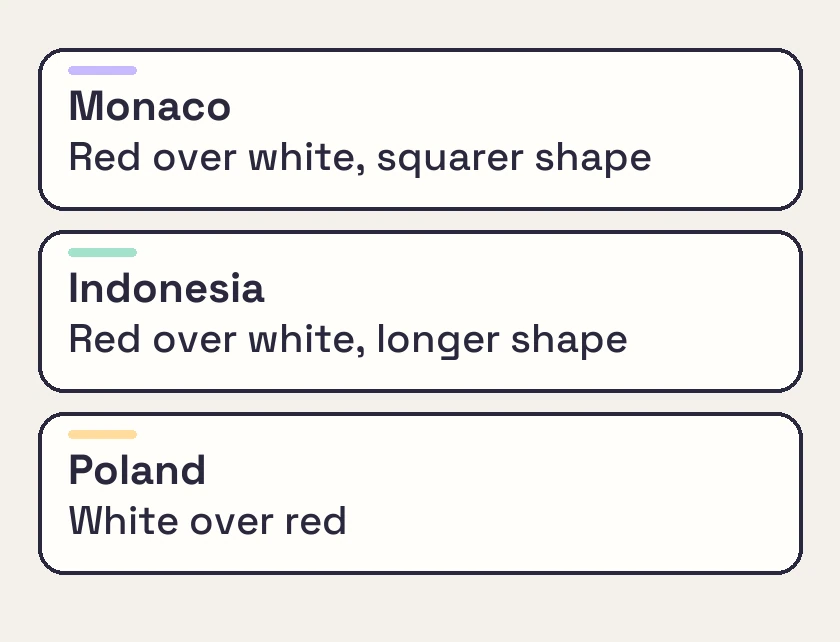
The order of the stripes. Poland has white on top. Ask for a description from top to bottom before any name.
Then compare Monaco and Indonesia, where only the proportions change.
Open the template · World flags quiz: 20 questions with answers
Six families to start with
Start with crosses, stars, three stripes, discs, animals and plants, then the shapes that stand apart. A family gives you something to hold on to: you no longer memorize a single drawing, you look for what sets it apart from its neighbours.
The most useful case is that of nearly identical flags. Monaco and Indonesia both have a red stripe above a white one: only the proportions differ. Mixing them up is not a memory mistake, it is an observation mistake.
A twenty-minute session
The plan below works with a whole class as well as around a table. All you need is pictures or an atlas.
- Five minutes: show one family of five to eight flags and ask for a description without names.
- Five minutes: hide the names, ask everyone to write the country, then check.
- Five minutes: ask about a symbol, such as the tree of Lebanon or the bird of Mexico.
- Five minutes: go back to the missed flags and to three flags from the previous session.
Twelve questions ready to ask
They come from the twenty-question quiz that goes with this guide. The answers were checked in the sources listed at the bottom of the page.
| Question | Answer | What to say next |
|---|---|---|
| Which country has a maple leaf on its flag? | Canada | The current flag was first raised on 15 February 1965, now celebrated as National Flag of Canada Day. |
| How many stars are on the flag of the United States? | 50 | One star per state: the fiftieth, for Hawaii, was added on 4 July 1960. The 13 stripes recall the original colonies. |
| Which country’s flag is white with a large red disc? | Japan | It is called the Hinomaru, the “circle of the sun”. Bangladesh also has a red disc, but on green; Palau has a yellow one on blue. |
| On China’s flag, all five stars are the same size. | False | One large star is flanked by four smaller ones in an arc, each with a point aimed at the centre of the big one. |
| How many stars are on the European Union flag? | 12 | The number is not tied to the member countries: the circle of twelve stands for unity, solidarity and harmony among the peoples. |
| Which tree appears on the flag of Lebanon? | A cedar | The flag dates from December 1943. The cedar, which grows in the country’s mountains, stands for immortality, steadfastness and hope. |
| Besides Vatican City, which other state has a square national flag? | Switzerland | Switzerland’s flag is a red square with a white cross. At sea, though, Swiss vessels fly a rectangular version. |
| Which country has a national flag that is neither rectangular nor square? | Nepal | Two stacked pennants carry the Moon and the Sun. The country’s constitution even explains, step by step, how to draw it. |
| On Mexico’s flag, which animal is holding a snake? | An eagle | Legend says this scene showed the Aztecs where to found their capital, Tenochtitlan, on the site of today’s Mexico City. |
| Which nation of the United Kingdom is not represented on this flag? | Wales | It combines the crosses of St George, St Andrew and St Patrick (1801). Wales, already united with England, is not shown. |
| Which motto appears on the flag of Brazil? | Order and Progress | The motto was inspired by philosopher Auguste Comte. On the globe, 27 stars stand for the 26 states and the Federal District. |
| Paraguay’s flag is different on each side. | True | One side shows the coat of arms with a star; the other shows the treasury seal with a lion. It is an exception among national flags. |
Ask the question both ways
Recognizing and producing are two different exercises. “Which country does this flag belong to?” asks you to recognize. “Describe the flag of Brazil” asks you to produce. Alternate the two: a flag you can describe comes back faster, and describing it reveals what you had not really looked at.
Three common mistakes
They make the exercise longer without making it more effective.
- Learning everything at once: fifty flags in one evening mostly leave confusion.
- Forgetting flags that have changed: check the date of your material before correcting anyone.
- Practising recognition only: add questions about the meaning of the symbols.
Play it with Pomlet in 5 steps
Everything above works on paper. A projected session saves you from counting points by hand. The names in quotation marks are the ones on screen.
- Start from the template: in your library, choose “Create session”, then “Choose a template”. Open “World flags quiz” and select “Use this template”.
- Adapt it: keep the questions that suit your group, change their order and add your own. The copy is yours.
- Set the pace: with small children, set “Time limit” to “No time limit” and close each question yourself with “End question”.
- Launch: choose “Play”, then “Classic” under “Live”. Everyone joins with the QR code or the PIN, with no app to install.
- Comment: after each question, the explanation is shown. Leave ten seconds for reactions before moving on.
The Free plan takes up to 8 participants per session. In a larger group, one phone per team is enough.
Keep the list of mix-ups
At the end, write down the pairs that were confused rather than the score. That short list is the best plan for the next session. The related quiz template has twenty questions about stars, colors and symbols, each with an explanation.
Useful links
Sources and further reading
- Which country has a maple leaf on its flag – Government of Canada
- How many stars are on the flag of the United States – Wikipedia
- Which country’s flag is white with a large red disc – Wikipedia
- On China’s flag, all five stars are the same size – Wikipedia
- How many stars are on the European Union flag – European Union
- Which tree appears on the flag of Lebanon – Wikipedia
- Besides Vatican City, which other state has a square national flag – Wikipedia
- Which country has a national flag that is neither rectangular nor square – Wikipedia
- On Mexico’s flag, which animal is holding a snake – Wikipedia
- Which nation of the United Kingdom is not represented on this flag – Royal Family
- Which motto appears on the flag of Brazil – Wikipedia
- Paraguay’s flag is different on each side – Wikipedia