
To teach an idiom, start from its picture rather than its definition. Have people draw what the words say, guess the meaning in a sentence, then show how another language says the same thing. The picture amuses, the sentence gives the meaning, and the comparison makes it stick.
The activity suits an English class, a language course or a family evening. Five idioms are enough for one session.
Worked example
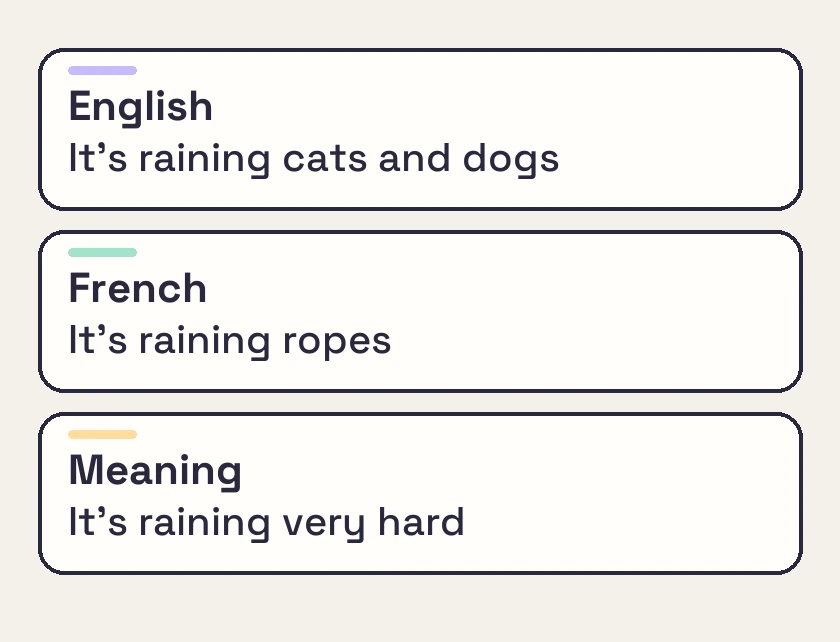
One picture, two languages
See the explanation
To look for the situation rather than the words. People say this while looking outside: the meaning becomes obvious.
Ask for a third picture in a language spoken in the class.
Open the template · English idioms quiz: 20 questions with answers
From drawing to meaning
Read “It’s raining cats and dogs” and allow one minute to draw exactly what the words say. The drawings make people laugh. Then ask when someone might say this sentence. The meaning comes from the situation, not from the dictionary.
Go on with a less transparent idiom. If the group hesitates, give a second sentence rather than a definition. Two well-chosen contexts are almost always enough.
A thirty-minute session
Make groups of three: one draws, one suggests, one checks. Roles rotate.
- Five minutes: one practice idiom.
- Fifteen minutes: five idioms, three minutes each.
- Five minutes: look for the equivalent in another language known to the group.
- Five minutes: write a short dialogue with two idioms.
Twelve questions ready to ask
They come from the twenty-question quiz that goes with this guide. The answers were checked in the sources listed at the bottom of the page.
| Question | Answer | What to say next |
|---|---|---|
| What does “It’s raining cats and dogs” mean? | It’s pouring | French speakers say it’s raining ropes, Spanish speakers pitchers, and Germans strings! |
| What does “It’s a piece of cake” mean? | It’s very easy | It’s cake in English and French, “eaten bread” in Spanish, and “child’s play” in German. |
| What does “To break the ice” mean? | To ease the tension | The same image exists in French, Spanish and German. It recalls a ship opening a path through ice. |
| What does “To kill two birds with one stone” mean? | To get a double result | The French also use one stone; Spanish speakers shoot two birds, and Germans swat two flies. |
| What does “Like two peas in a pod” mean? | Almost identical | Peas in English, drops of water in French and Spanish, eggs in German: every language has its twins. |
| What does “Once in a blue moon” mean? | Very rarely | French speakers wait for the 36th of the month, which never comes! Germans wait for a jubilee year. |
| What does “To pull someone’s leg” mean? | To fool them | It’s the hair in Spanish, the arm in German and a boat in French: every language grabs something else! |
| What does “Crocodile tears” mean? | Fake sorrow | People once thought crocodiles wept while eating their prey. Their eyes do water, but without emotion. |
| What does “When pigs fly” mean? | Never | Hens with teeth in French, hairy frogs in Spanish, a made-up saint’s day in German: so many ways to say never! |
| What does “To hit the nail on the head” mean? | To be exactly right | French speakers hit the bull’s-eye; Spanish and German speakers, like English ones, hit a nail. |
| What does “To bury your head in the sand” mean? | To ignore a problem | All four languages share the image, but it rests on a mistake: ostriches don’t bury their heads in the sand. |
| What does “To call a spade a spade” mean? | To speak plainly | A cat in French, bread and wine in Spanish, a child in German: each names what it knows best! |
Let other languages speak
Ask who knows the idiom in another language. Where English sees cats and dogs fall, French sees ropes. This moment gives everyone’s languages a place, and shows that the pictures change while the meaning stays close.
Three common mistakes
They turn a game into a list to learn.
- Twenty idioms at once: the pictures blur and nothing stays.
- Origins told without a source: many explanations are charming and cannot be checked, so say when nobody knows.
- Hurtful idioms: leave out those that target a group of people.
Play it with Pomlet in 5 steps
Everything above works on paper. A projected session saves you from counting points by hand. The names in quotation marks are the ones on screen.
- Start from the template: in your library, choose “Create session”, then “Choose a template”. Open “English idioms quiz” and select “Use this template”.
- Adapt it: keep the questions that suit your group, change their order and add your own. The copy is yours.
- Set the pace: with small children, set “Time limit” to “No time limit” and close each question yourself with “End question”.
- Launch: choose “Play”, then “Classic” under “Live”. Everyone joins with the QR code or the PIN, with no app to install.
- Comment: after each question, the explanation is shown. Leave ten seconds for reactions before moving on.
The Free plan takes up to 8 participants per session. In a larger group, one phone per team is enough.
Use it again the next day
Start the next lesson with a sentence in which the idiom is missing. If someone finds it, it has been learned. The related template offers twenty idioms, their meaning and their cousins in other languages.
Useful links
Sources and further reading
- What does “It’s raining cats and dogs” mean – Cambridge Dictionary
- What does “It’s a piece of cake” mean – Cambridge Dictionary
- What does “To break the ice” mean – Cambridge Dictionary
- What does “To kill two birds with one stone” mean – Cambridge Dictionary
- What does “Like two peas in a pod” mean – Cambridge Dictionary
- What does “Once in a blue moon” mean – Cambridge Dictionary
- What does “To pull someone’s leg” mean – Cambridge Dictionary
- What does “Crocodile tears” mean – Cambridge Dictionary
- What does “When pigs fly” mean – Wiktionary
- What does “To hit the nail on the head” mean – Cambridge Dictionary
- What does “To bury your head in the sand” mean – Cambridge Dictionary
- What does “To call a spade a spade” mean – Cambridge Dictionary