
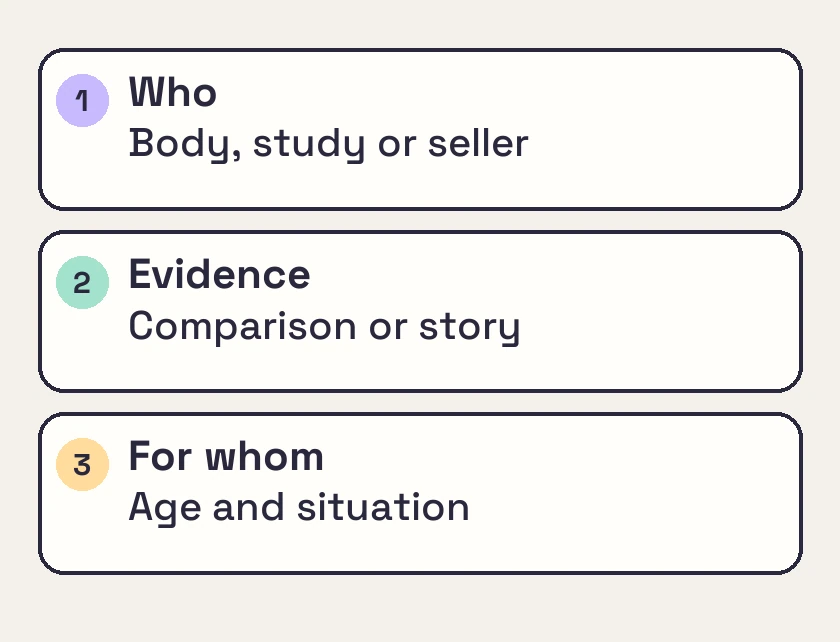
To check a health claim, ask four questions: who says so, on what evidence, for whom, and since when. If one of them has no answer, the claim is not necessarily false, but it is not usable yet. This activity teaches people to look things up, not to treat anyone: for a personal situation, talk to a health professional.
Health myths travel fast because they are simple, passed on by people we trust and often reassuring. Correcting them means understanding why they seem true.
Worked example
One claim under the microscope
See the explanation
Look for the organization or the publication. Without a name or a source, the first question has no answer: do not pass the message on.
Rewrite the information with the source, the date and the people concerned.
Open the template · Health myths: true or false? 20 answers explained
The four questions
Who says so? A public health body, a study, or someone selling something? On what evidence? A comparison between groups, or a personal story? For whom? A healthy adult, a child, someone who is ill? Since when? Recommendations change.
Take the idea that sugar makes children hyperactive. Trials in which neither families nor children knew who had received sugar did not show that effect. Without that precaution, adults’ expectations are enough to change what they think they see.
A thirty-minute activity
Work in groups of three, with one statement per group.
- Five minutes: read the statement and bet.
- Ten minutes: find two sources and answer the four questions.
- Ten minutes: each group presents its strongest source.
- Five minutes: replay the statements as true or false.
Twelve questions ready to ask
They come from the twenty-question quiz that goes with this guide. The answers were checked in the sources listed at the bottom of the page.
| Question | Answer | What to say next |
|---|---|---|
| Soap and water remove germs better than water alone. | True | Soap lifts grease and germs off the skin, then water carries them away. Scrub for at least 20 seconds. |
| Going out with wet hair gives you a cold. | False | You have to be infected by a virus. Colds are more common in winter, partly because dry air can lower our resistance. |
| Antibiotics cure the flu. | False | Flu is caused by a virus; antibiotics only work on bacteria. Misusing them helps bacteria become resistant. |
| Teenagers need more sleep than adults. | True | Experts recommend 8 to 10 hours from age 13 to 18, and at least 7 hours for adults. |
| Sugar makes children hyperactive. | False | Comparing sugar with a placebo, a review of 23 trials found no overall effect on behavior. But sugar does harm teeth! |
| You can become allergic to a food you used to eat without trouble. | True | Food allergies can start in adulthood. Shellfish is among the common causes. |
| Eating lots of carrots lets you see in the dark. | False | Unless you lack vitamin A, eating more won’t improve your night vision. The idea was popularized in 1940s Britain. |
| For a nosebleed, you should tilt your head back. | False | Leaning back lets blood run down the throat. Lean forward and pinch the soft part of the nose for 10 to 15 minutes. |
| Sunscreen is useful even on a cloudy day. | True | Up to 80% of UV rays can pass through clouds. Snow, sand and water also reflect them. |
| Brisk walking counts as physical activity. | True | The WHO advises adults to get at least 150 minutes a week of moderate activity, such as brisk walking. |
| Putting butter on a minor burn helps it heal. | False | The UK’s NHS advises 20 minutes of cool running water, as soon as possible. No butter, oil or ice. |
| Rust on a nail is what causes tetanus. | False | The bacterium lives in soil and manure, among other places, so any dirty wound can be a risk. Vaccination protects. |
Correct without frightening anyone
Say what is useful first: the recommended action, the number to call, when to see someone. Then explain why the myth is wrong. A correction that leaves only worry is soon forgotten, while a simple action is remembered.
Three traps
They come back in almost every discussion.
- Correlation: two things that happen together are not necessarily linked.
- The testimonial: a recovery story says nothing about what would have happened otherwise.
- The forgotten date: a first-aid instruction may have changed since your training.
Play it with Pomlet in 5 steps
Everything above works on paper. A projected session saves you from counting points by hand. The names in quotation marks are the ones on screen.
- Start from the template: in your library, choose “Create session”, then “Choose a template”. Open “True or false: everyday health” and select “Use this template”.
- Adapt it: keep the questions that suit your group, change their order and add your own. The copy is yours.
- Set the pace: with small children, set “Time limit” to “No time limit” and close each question yourself with “End question”.
- Launch: choose “Play”, then “Classic” under “Live”. Everyone joins with the QR code or the PIN, with no app to install.
- Comment: after each question, the explanation is shown. Leave ten seconds for reactions before moving on.
The Free plan takes up to 8 participants per session. In a larger group, one phone per team is enough.
Keep the method
People forget the statements and keep the four questions. Put them on the wall and use them with the next message you receive. The related template offers twenty statements, each with its source.
Useful links
Sources and further reading
- Soap and water remove germs better than water alone – London School of Hygiene study (PMC)
- Going out with wet hair gives you a cold – Nemours KidsHealth
- Antibiotics cure the flu – NHS
- Teenagers need more sleep than adults – NHLBI (NIH)
- Sugar makes children hyperactive – JAMA 1995 (NLM abstract)
- You can become allergic to a food you used to eat without trouble – ACAAI
- Eating lots of carrots lets you see in the dark – NPR / Harvard Health
- For a nosebleed, you should tilt your head back – NHS
- Sunscreen is useful even on a cloudy day – American Academy of Dermatology
- Brisk walking counts as physical activity – OMS
- Putting butter on a minor burn helps it heal – NHS
- Rust on a nail is what causes tetanus – OMS