
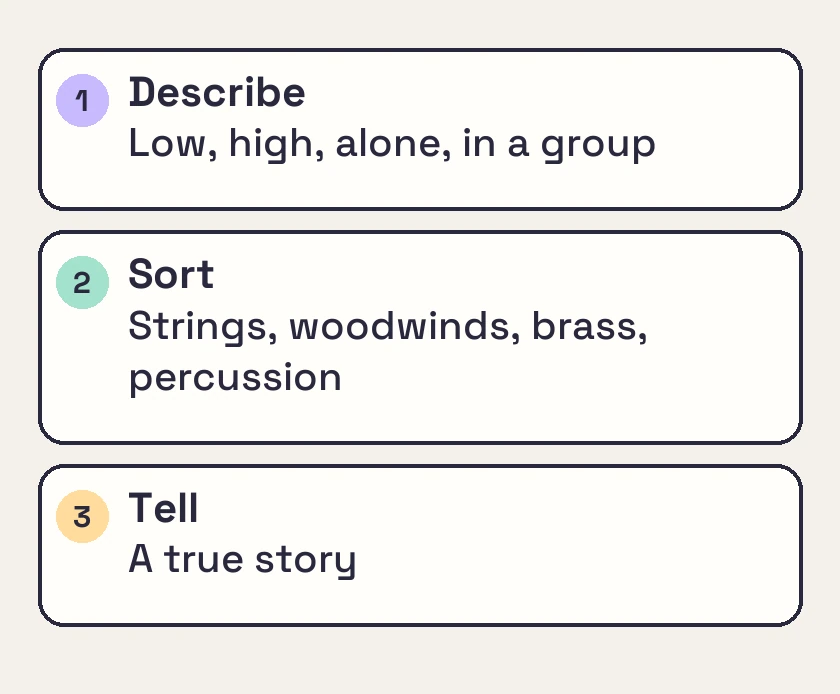
To introduce classical music with a quiz, start with what everyone can hear: low or high, alone or in a group, wind or strings. The names of works come later, attached to a story. A quiz that starts with titles sorts those who already know; a quiz that starts with listening lets the others in.
You do not need to be a musician to run the session. You need short questions, a recording you are allowed to use and the time to listen twice.
Worked example
One listening, three questions
See the explanation
That the intuition is sound, since it is made of metal. Show the reed: the reed, not the material, places it with the woodwinds.
Ask which other metal instrument makes its sound without the lips.
Open the template · Classical music trivia: 20 questions, answers
Start from the families of instruments
Strings, woodwinds, brass, percussion: these four families give an immediate vocabulary. The saxophone comes as a surprise, because it is made of metal and yet belongs to the woodwinds, on account of its reed. A well-explained exception fixes the rule better than ten examples that follow it.
Then ask which character would suit each sound. Prokofiev did it before you in “Peter and the Wolf”, where each instrument plays a part. The answer can be discussed, while the description of the sound becomes precise.
A forty-minute session
The session alternates listening, betting and storytelling. Keep the excerpts short.
- Five minutes: recognize low, high, alone, several.
- Fifteen minutes: six questions about families and roles, with one listening for each.
- Ten minutes: a whole piece or a movement, with no question.
- Ten minutes: everyone writes a sentence about what they heard, then a few are read aloud.
Twelve questions ready to ask
They come from the twenty-question quiz that goes with this guide. The answers were checked in the sources listed at the bottom of the page.
| Question | Answer | What to say next |
|---|---|---|
| Which family does the cello belong to? | Strings | It is played sitting down, resting on an endpin. It is tuned an octave below the viola. |
| About how old was Mozart when he wrote his first little pieces? | 5 | His father Leopold wrote them down in a notebook for his older sister. At six, he was playing for the courts of Europe. |
| Beethoven was almost completely deaf when his Ninth Symphony premiered. | True | In Vienna in 1824, a singer is said to have turned him around to see the applause he could not hear. |
| How many keys does a standard modern piano have? | 88 | That covers just over seven octaves. The first pianos, around 1700, had only about fifty. |
| Orchestras usually tune to a note played by the oboe. | True | Its clear, penetrating sound carries well and its pitch is steady. It gives an A to the other players. |
| Who composed the opera “Carmen”? | Georges Bizet | Coolly received in Paris, it became one of the world’s most performed operas. Bizet died three months after the premiere. |
| In music, what does the marking “piano” ask for? | Play softly | The instrument was first called “pianoforte” because, unlike the harpsichord, it could play both softly and loudly. |
| The saxophone belongs to the brass family. | False | Its body is metal, but the sound comes from a reed, as in the clarinet. That makes it a woodwind. |
| Which instrument plays the duck in Prokofiev’s “Peter and the Wolf”? | The oboe | The flute is the bird, the clarinet the cat, the bassoon the grandfather and three horns the wolf. Peter gets the strings. |
| In which city did the first public opera house open, in 1637? | Venice | Until then, opera was performed in palaces. At the San Cassiano, all you needed was a ticket. |
| Which work by Ravel is built on one snare drum rhythm from start to finish? | Boléro | For about 15 minutes, the tune passes between instruments as the orchestra slowly swells. It began as a ballet. |
| Stradivari’s violins were made in Cremona, Italy. | True | Antonio Stradivari worked there until his death in 1737. Cremona’s violin craftsmanship is on UNESCO’s heritage list. |
Choose stories that have been checked
Classical music carries many legends. Before telling one, look for the source: a museum, a library, the publisher of the score. If a story is charming but doubtful, say that it is doubtful. Learners readily remember that a legend can be famous and false.
Three habits to drop
They suggest that you must already know in order to listen.
- Starting with the composer’s name: people look for the right answer instead of listening.
- Playing ten excerpts in a row: the ear gets tired and everything blurs.
- Using a recording found at random: the score may be old while the recording is still protected.
Play it with Pomlet in 5 steps
Everything above works on paper. A projected session saves you from counting points by hand. The names in quotation marks are the ones on screen.
- Start from the template: in your library, choose “Create session”, then “Choose a template”. Open “Classical music trivia: composers and instruments” and select “Use this template”.
- Adapt it: keep the questions that suit your group, change their order and add your own. The copy is yours.
- Set the pace: with small children, set “Time limit” to “No time limit” and close each question yourself with “End question”.
- Launch: choose “Play”, then “Classic” under “Live”. Everyone joins with the QR code or the PIN, with no app to install.
- Comment: after each question, the explanation is shown. Leave ten seconds for reactions before moving on.
The Free plan takes up to 8 participants per session. In a larger group, one phone per team is enough.
Return to listening
End with the first piece of the session, with no question. People almost always hear more the second time. The related template offers twenty questions without excerpts, to complete with your own listening.
Useful links
Sources and further reading
- Which family does the cello belong to – Philharmonia Orchestra
- About how old was Mozart when he wrote his first little pieces – King’s College London (Mozart)
- Beethoven was almost completely deaf when his Ninth Symphony premiered – HISTORY
- How many keys does a standard modern piano have – Yamaha
- Orchestras usually tune to a note played by the oboe – Rockford Symphony
- Who composed the opera “Carmen” – English National Opera
- In music, what does the marking “piano” ask for – Lumen Learning
- The saxophone belongs to the brass family – Yamaha
- Which instrument plays the duck in Prokofiev’s “Peter and the Wolf” – Hollywood Bowl / LA Phil
- In which city did the first public opera house open, in 1637 – Istituto Italiano di Cultura
- Which work by Ravel is built on one snare drum rhythm from start to finish – Classic FM
- Stradivari’s violins were made in Cremona, Italy – Encyclopedia.com (Gale)