
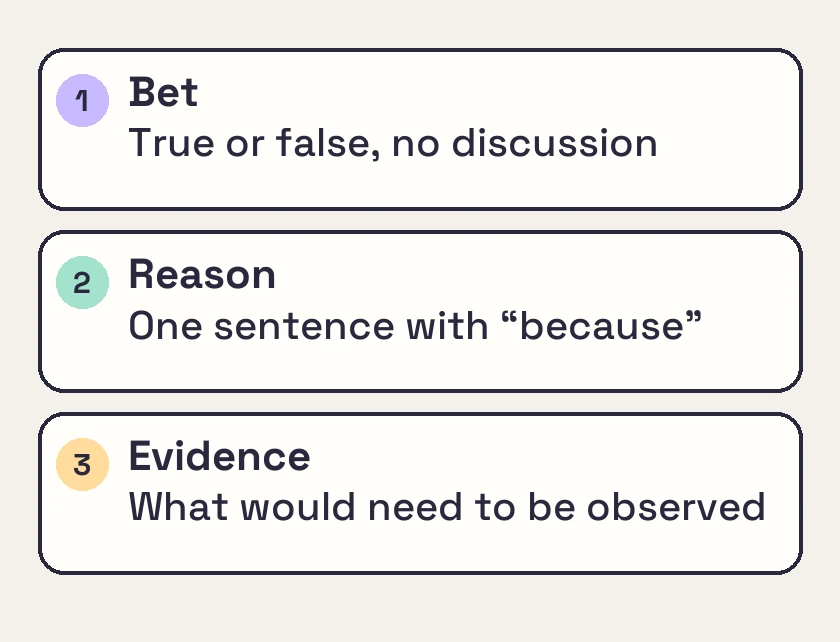
To work on a misconception about the human body, ask for a bet first, then a reason, and only then give the answer. A true-or-false game played too fast only counts points. Played in three steps, it shows what each person believes, why they believe it and what could settle the matter.
The human body suits the exercise because everyone has an experience to share. That is also the difficulty: one personal experience is not enough to establish a general rule.
Worked example
One statement in three steps
See the explanation
A possible observation. The source is a trusted person, but it does not say how to check. Help them find a simple measurement.
Keep the first sentence: it will be useful to compare with the corrected version.
Open the template · Human body myths: true or false? 20 statements
The bet, the reason, the evidence
Read the statement twice. Everyone writes true or false, then a sentence starting with “because”. Add a confidence score from one to three. That score changes the discussion: a mistake made with confidence deserves more time than a hesitation.
Then ask what would need to be observed. For height in the morning and evening, a wall chart and a notebook are enough. For the tongue, a cotton swab and a little salt will do, provided nobody has an allergy or a special diet.
Thirty minutes, six statements
Six well-discussed statements are worth more than twenty rushed ones. Mix the answers so that no pattern can be guessed.
- Minutes 0 to 5: read the rule and play a practice statement.
- Minutes 5 to 22: six statements, three minutes each, including one for the reasons.
- Minutes 22 to 26: return to the one that fooled the most people.
- Minutes 26 to 30: everyone restates one corrected idea in a sentence.
Twelve questions ready to ask
They come from the twenty-question quiz that goes with this guide. The answers were checked in the sources listed at the bottom of the page.
| Question | Answer | What to say next |
|---|---|---|
| Each area of the tongue detects only one taste. | False | Sweet, salty, sour, bitter and umami are sensed all over the tongue. The famous “map” comes from a misread 1901 study. |
| Cracking your knuckles causes arthritis. | False | The pop comes from gas in the joint fluid. One doctor cracked only his left hand for over 50 years and found no difference! |
| The femur is the longest bone in the human body. | True | It makes up about a quarter of a person’s height, and it is also one of the strongest bones in the body. |
| Identical twins have the same fingerprints. | False | They form before birth and also depend on tiny differences in the womb, so even identical twins can be told apart. |
| Reading in dim light permanently damages your eyesight. | False | Your eyes blink less and get tired, but reading in dim light does not harm them: a little rest is enough. |
| The smallest bone in the body is in the ear. | True | It is the stapes, named after a stirrup because of its shape. With the hammer and anvil, it carries vibrations to the inner ear. |
| Shaved hair grows back thicker. | False | Shaving does not change thickness, color or growth rate. The blunt cut tip just feels coarser. |
| Toenails grow faster than fingernails. | False | Fingernails grow about 3.5 mm a month, toenails only about 1.6 mm. |
| After part of it is removed, the liver can grow back to size. | True | That is why a healthy person can donate part of their liver: most of the volume comes back within weeks to months. |
| Most nutrients enter the blood through the stomach. | False | The stomach churns and starts digestion. Then the small intestine, long and heavily folded, absorbs most nutrients. |
| You’re slightly taller in the morning than in the evening. | True | During the day, gravity squeezes the discs between the vertebrae. At night, when you lie down, they soak water back up. |
| Sneezing with your eyes open makes them pop out. | False | Closing your eyes is a reflex, but some people keep them open with no harm: muscles hold the eyes firmly in place. |
Correct without embarrassing anyone
Say where the idea comes from before saying that it is wrong. The tongue map, for instance, used to appear in books. Explaining the origin of the mistake avoids suggesting that only careless people get it wrong, and it gives a reason to check the diagrams we copy.
Three traps
They turn a science activity into a guessing game.
- The loose question: always specify “in adults”, “at rest” or “in general”.
- The decisive anecdote: one case illustrates, it does not prove.
- Medical advice: this kind of quiz informs, it does not replace a health professional.
Play it with Pomlet in 5 steps
Everything above works on paper. A projected session saves you from counting points by hand. The names in quotation marks are the ones on screen.
- Start from the template: in your library, choose “Create session”, then “Choose a template”. Open “True or false: the human body” and select “Use this template”.
- Adapt it: keep the questions that suit your group, change their order and add your own. The copy is yours.
- Set the pace: with small children, set “Time limit” to “No time limit” and close each question yourself with “End question”.
- Launch: choose “Play”, then “Classic” under “Live”. Everyone joins with the QR code or the PIN, with no app to install.
- Comment: after each question, the explanation is shown. Leave ten seconds for reactions before moving on.
The Free plan takes up to 8 participants per session. In a larger group, one phone per team is enough.
Ask again later
A correction heard once is soon forgotten. Keep the two statements that were missed most and ask them again a week later, in different words. The related template offers twenty explained statements, in the order of the video.
Useful links
Sources and further reading
- Each area of the tongue detects only one taste – NIDCD
- Cracking your knuckles causes arthritis – Harvard Health
- The femur is the longest bone in the human body – Cleveland Clinic
- Identical twins have the same fingerprints – MedlinePlus
- Reading in dim light permanently damages your eyesight – University of Utah Health
- The smallest bone in the body is in the ear – Wikipedia
- Shaved hair grows back thicker – Cleveland Clinic
- Toenails grow faster than fingernails – BioNumbers, Harvard
- After part of it is removed, the liver can grow back to size – Cleveland Clinic
- Most nutrients enter the blood through the stomach – NIDDK
- You’re slightly taller in the morning than in the evening – Scientific Reports (PMC)
- Sneezing with your eyes open makes them pop out – NBC News